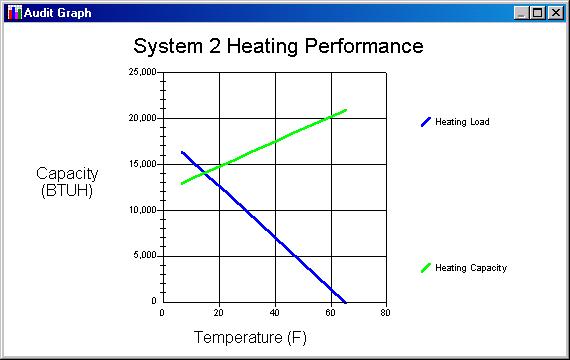
Graph of heat pump balance point from Elite Software
2 thoughts on “heat pump balance point”
Thank you,
Just found your site and hope you can help. I have a 1238 sq ft home in Ashford, WA (elev, 2,000 ft). The builder installed a 2 ton electric, heat pump ready, heating system. When I asked about having a 2 1/2 ton heat pump installed, the HVAC contractor (original installer) stated that the air handler (newspeak for furnace) wouldn’t work for it as it would be too small (move too little air) and that that particular unit could not be modified to accommodate the larger load (probably move that much additional air).
Is the contractor just coloring inside the lines? While he states the two ton unit accommodates up to 1,800 sq ft, our temps dip below zero. 3 yr old home with R38 ceilings, R19 walls, R25 floors and under 17% windows. Electricity is 4.5 cents a kw here (lowest in the nation I heard) but I here a 4 to 1 energy savings (seasonal) with heat pump.
Also, while I’m asking, I see a 40% or less average satisfaction with heat pumps (all manufacturers) since the refrigeration type changed or the race for the SEER ratings started. Where the old GE units lasted 30 years, the Carriers, Tranes, their generic brand names (American Standard, etc) and others suffer frequent (relative term) breakdowns and failures. It it a prudent idea to even install one? We would only enjoy the cooling side 2-6 weeks a season.
Ted V
@ the ft of Mt Rainier
ps, I installed a 20kw generac w/auto transfer switch, it would have to meet the locked rotor amp draw starting a heat pump
It’s impossible to answer without doing some measurements and/or calculations, but here’s some data for you.
The difference between a 2 ton and 2 1/2 ton system is relatively small. Most systems are designed to move 400 CFM (cubic feet per minute) of air per ton of capacity, so you’re looking at either 800 or 1000 CFM. Many duct systems are already undersized so that the pressure the air handler experiences is already too high, but there’s no way to know without actually measuring the size and distribution of the ducts in your home. There’s something called “Manual-D” which is used for this purpose. Here’s a link that might help explain it, or just Google it.
Rather than replacing your main unit, have you considered adding a mini-split for point of use heating? The mini-split can be much more efficient than any new system you’d install, and you can have it installed in the main room where you spend most of your time. This allows you to keep the rest of your house cooler and save even more money. These systems are amazing and likely a perfect solution for the type of situation you have since they also adjust their output, typically anywhere from 1/4 ton to a 1.5 tons. I’ve got a couple Fujitsu 12-RLS units in my home and love them. I’ve got a generator also and these Fujitsu units are “soft-start” with electronically controlled motors, so you don’t have to worry about the high start-up amperage. The generator just sees a gradually increasing load. Unlike a typical central system which is “bang-on”, causing that double sized inductive load surge at startup.
As for your second question, I’ve heard that there are multiple factors at play with the low satisfaction ratings, but lack of durability is a primary one. The issue is that the new systems work at much higher pressures. At the same time, manufacturers are using thinner tubing, both to save money and to increase efficiency. This is a bad combination leading to shorter life spans. Additionally, higher pressures means the compressors have to work harder. The other issue is that it seems that there are a lot more bozos out there installing heat pumps who have no concept of balance point or other issues critical to happy heat pump operation. So you see a lot of people who think they’re going to save big by using a heat pump and end up with outrageously high electric bills combined with poor comfort. I’d be dissatisfied too!

 Ted's Energy Tips
Thank you,
Just found your site and hope you can help. I have a 1238 sq ft home in Ashford, WA (elev, 2,000 ft). The builder installed a 2 ton electric, heat pump ready, heating system. When I asked about having a 2 1/2 ton heat pump installed, the HVAC contractor (original installer) stated that the air handler (newspeak for furnace) wouldn’t work for it as it would be too small (move too little air) and that that particular unit could not be modified to accommodate the larger load (probably move that much additional air).
Is the contractor just coloring inside the lines? While he states the two ton unit accommodates up to 1,800 sq ft, our temps dip below zero. 3 yr old home with R38 ceilings, R19 walls, R25 floors and under 17% windows. Electricity is 4.5 cents a kw here (lowest in the nation I heard) but I here a 4 to 1 energy savings (seasonal) with heat pump.
Also, while I’m asking, I see a 40% or less average satisfaction with heat pumps (all manufacturers) since the refrigeration type changed or the race for the SEER ratings started. Where the old GE units lasted 30 years, the Carriers, Tranes, their generic brand names (American Standard, etc) and others suffer frequent (relative term) breakdowns and failures. It it a prudent idea to even install one? We would only enjoy the cooling side 2-6 weeks a season.
Ted V
@ the ft of Mt Rainier
ps, I installed a 20kw generac w/auto transfer switch, it would have to meet the locked rotor amp draw starting a heat pump
It’s impossible to answer without doing some measurements and/or calculations, but here’s some data for you.
The difference between a 2 ton and 2 1/2 ton system is relatively small. Most systems are designed to move 400 CFM (cubic feet per minute) of air per ton of capacity, so you’re looking at either 800 or 1000 CFM. Many duct systems are already undersized so that the pressure the air handler experiences is already too high, but there’s no way to know without actually measuring the size and distribution of the ducts in your home. There’s something called “Manual-D” which is used for this purpose. Here’s a link that might help explain it, or just Google it.
Rather than replacing your main unit, have you considered adding a mini-split for point of use heating? The mini-split can be much more efficient than any new system you’d install, and you can have it installed in the main room where you spend most of your time. This allows you to keep the rest of your house cooler and save even more money. These systems are amazing and likely a perfect solution for the type of situation you have since they also adjust their output, typically anywhere from 1/4 ton to a 1.5 tons. I’ve got a couple Fujitsu 12-RLS units in my home and love them. I’ve got a generator also and these Fujitsu units are “soft-start” with electronically controlled motors, so you don’t have to worry about the high start-up amperage. The generator just sees a gradually increasing load. Unlike a typical central system which is “bang-on”, causing that double sized inductive load surge at startup.
As for your second question, I’ve heard that there are multiple factors at play with the low satisfaction ratings, but lack of durability is a primary one. The issue is that the new systems work at much higher pressures. At the same time, manufacturers are using thinner tubing, both to save money and to increase efficiency. This is a bad combination leading to shorter life spans. Additionally, higher pressures means the compressors have to work harder. The other issue is that it seems that there are a lot more bozos out there installing heat pumps who have no concept of balance point or other issues critical to happy heat pump operation. So you see a lot of people who think they’re going to save big by using a heat pump and end up with outrageously high electric bills combined with poor comfort. I’d be dissatisfied too!