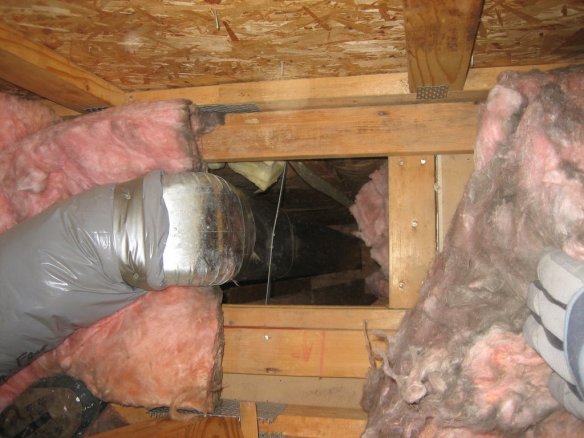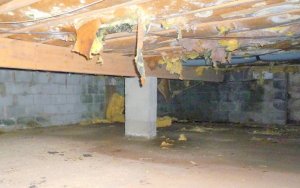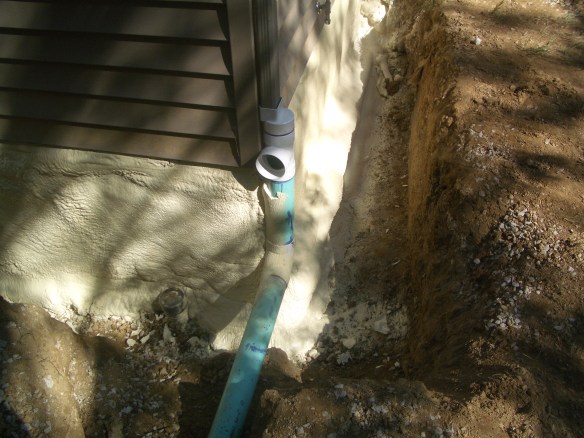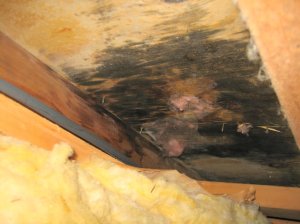
What does it mean if your fiberglass insulation is black?

Insulation filters the air leaks from your house, showing you signs of energy loss

You might have noticed some black insulation in your attic or maybe around the perimeter of your basement, where the house rests on the foundation. What does this mean? Is it moldy? Wet? Why is the insulation black?

In fact, black insulation is the energy auditor’s best friend because it tells us where the problems are. In just a few minutes of looking around the attic, you can find the most serious air leaks from the house. Here’s why…

Continue reading

Home Energy Magazine

If you like this blog, then you’ll really like Home Energy Magazine!

Here’s their promo for the latest issue:

If there’s one thing contributing editor Steve Mann learned while attending the 2010 Passive House Conference in Portland, Oregon, it’s that the Passive House approach is anything but passive. In this issue of Home Energy, Steve explains the history of the Passive House standard, where it stands today, and what its future holds. Steve is a HERS rater, Green Point rater, LEED AP, Certified Energy Analyst, serial remodeler, and longtime software engineer.

Read the excerpts below to learn why senior building science consultant John Tooley says we need to Raise the Bar for Home Performance, and how a standard retrofit package can save a homeowner money in The Robo Retrofit House. This issue also features real-life horror stories from the field of energy auditing and a look into how students at Syracuse University experienced a Multifamily Performance Program in on-campus housing.

Click here to access the current issue. If you are a current online subscriber to Home Energy, click here to log in.

Cathedral Ceilings – Mold and Moisture – Problems and Solutions

Rotten roof deck

Disclaimer: while I think all the information presented here is accurate and scientifically valid, you are advised to consult a *professional before changing your home. This article covers just one component of your home. Your specific home may have conditions that override the comments contained herein.

*By professional, I mean an experienced building scientist, not your local carpenter or roofer or even a structural engineer or architect. While many of these people are artists in what they do, most have no training in building science or engineering and cannot be trusted to properly design a roof assembly. Likewise, you wouldn’t hire a building scientist to swing a hammer and build your roof!
Cathedral ceilings are very popular – they give rooms a feeling of openness and an added aesthetic dimension. At the same time, they are responsible for a variety of building problems and homeowner heartbreak. What causes these problems and how do you avoid them?

There are a variety of climate zones. The south-eastern United States is hot and humid, while the north east is cold. The mid-Atlantic states, where I live, is mixed – during the summer it is hot and humid, during the winter it is cold. The south west is mostly hot and dry and the northwest is moderate in temperature but very humid! Each of these climate zones has its own particular building details. However, all must follow the laws of physics.

Physics tells us that moisture moves from areas of high humidity to areas of low humidity. If it’s more humid outside, moisture wants to come in. And when it’s more humid inside, the moisture will move toward the outside. Simple!

Continue reading

Videos on insulating and sealing a crawlspace

Here’s a handy, albeit highly incomplete, video on insulating your crawlspace:

Insulation installed upside-down

The positives:

  • They installed it with the vapor barrier put firmly up against the floor of the room above – this is actually correct. Most people install it upside-down and staple the paper vapor to the floor joists – this is totally incorrect. When you do that, you end up with moldy insulation like shown here.
  • They stressed the importance of air sealing and even showed the band joists (technically called the “rim joist”). Kudos for that!

The not-so-good:

  • They noted the importance of installing a vapor barrier on the floor, though they should have mentioned that you typically only do that for a dirt floor. They should also have mentioned that just laying plastic on the floor won’t do much to stop moisture from coming up. Any place air can flow, water vapor will go!
  • They used fiberglass (of course) on the rim joists. Unfortunately, this can lead to moisture damage. See this excellent article in Fine Homebuilding (PDF file) on insulating the rim joist.

Superb video on a crawlspace sealing system

The next (commercial) video presents the situation in crawlspaces accurately and proposes a solution that appears to be done thoroughly and professionally. Note that I have no personal experience with the company that produced the video. Regardless, it is well worth a view.

___________________

Here’s a very nice article on insulating your crawl space by the Dept. of Energy. They get the rim joist insulation wrong though…

Fine Homebuilding article showing the proper way to insulate the rim joist.

Family Handyman article on installing a vapor barrier in your crawlspace.

Types of insulation: part 3-Insulations compared

Signs of moisture and air flow in fiberglass insulation

When you climb into an attic and see this, you know something is seriously wrong. In fact, if your home isn’t very old, your insulation should be clean like when it was installed. The reason you get black insulation like this is because air and moisture are moving through the insulation, and it’s acting like an air filter.

The reason I’m showing you this picture is because it’s an example of the wrong insulation being used for a job. I feel pretty strongly about this because I’ve seen numerous homes where fiberglass has been installed in open walls like this and in almost every case, the insulation was seriously compromised – it was buckling under its own weight or simply falling out of the wall cavity. Or, in cases like this, it was hiding a big hole in the wall that should have been air sealed.

Let’s walk through the different insulation types and compare their main attributes: R-value, ability to reduce air movement, suitability for retrofit applications, and other characteristics.

Continue reading

Guest post: How I dealt with water problems and saved the house

Crawlspace walls after foaming

My good friend Jerry takes to the keyboard today, telling us the trials and tribulations of having a house adjacent to a hill….

__________________________

We bought the house not knowing the backyard had really bad water retention issues (note: never buy a house when there’s snow covering the yard).  After heavy rain in the spring, the back yard would essentially be an unmowable mudpit for several weeks.  We had French drains installed which greatly alleviated the issue.  With the remodel, we figured we’d further address the wet yard by channeling the downspouts from the gutters in the back of the house into an underground collection pit (a dry well), which would run off into a rocky bed leading to the street.  This also worked well.

Unfortunately, during construction they built an open crawlspace under what would later become the kitchen extension.  Open to the sun and the stars…and the rain.  The first rain after they built it happened on a weekend.  The carpenter/job manager came over without us even calling, luckily, and build a makeshift cover out of plywood.  But it was a heavy rain and we had to run and get a pump as well to keep the crawlspace from filling up and coming into the basement.  Eventually they built the kitchen over it, and that was the end of that.  Or so we thought.

Types of Insulation: Part 2 – Where does insulation go?

In part 1 of this series, I gave you an overview of the different insulation materials and the various forms they come in. This article covers where insulation goes and why. Knowing this helps you understand why you’d want to use a particular type of insulation for specific applications in your home.

Where do you use insulation?

  • On the attic floor
  • In attic cavities
  • On an attic knee wall
  • On the attic ceiling
  • In the walls
  • Around the windows and doors
  • Around pipes and other holes in the wall
  • In the basement and crawlspace ceilings
  • On the basement and crawlspace walls
  • Under the slab
  • Outside the foundations

Each of these areas really deserves an article of its own. In fact, if you look on the Building Science website, you’ll find highly detailed articles doing exactly that.  If you want to go straight to the source, consult these references.

Let’s look at some photos to get an idea of several of these cases…

Continue reading

Q&A – Types of Insulation

Bonded Logic Denim Insulation

When you insulate your house, you’re going to be confronted by a dizzying array of choices. How do you know which one to use? How much do they cost? Are some better than others or is it all hype? In this article, I’m going to do my best to sort through the options and help you make sense of them. Be warned – there’s a LOT of material here, so I’m going to have to break this into several articles.

First, let’s survey the types of insulation that you’re likely to encounter. I’m also going to provide links where appropriate.

  • Fiberglass – batts
  • Fiberglass – dense batts
  • Fiberglass – compressed
  • Fiberglass – shredded / loose fill
  • Fiberglass – Johns Manville Spider – sprayed in
  • Cellulose – loose fill
  • Cellulose – damp sprayed in
  • Cellulose – dense packed
  • Spray foam – open-cell, Icynene
  • Spray foam – open-cell, soy based
  • Spray foam – high-density closed-cell
  • Spray foam – high-density closed-cell, soy based
  • Board foam – expanded polystyrene
  • Board foam – extruded polystyrene
  • Board foam – polyisocyanurate
  • Board foam – foil faced polyisocyanurate
  • Denim – Bonded Logic batts

This list is long enough. There are other insulation materials that have been used over the years, from vermiculite to horse hair to rice hulls to straw bales, but I’m not going to touch on anything that isn’t commonly available in the United States. Sorry!

Insulation Characteristics

Before we go into analyzing all the details of insulation materials, let’s spend a moment defining the basic characteristic of insulation – the R-value.

Continue reading

Retrofit your attic hatch for improved comfort and energy efficiency

Link: Retrofit your attic hatch for improved comfort and energy efficiency

Thermal image of leaky attic hatch

The typical attic hatch is drafty and improperly insulated. Fixing it can reduce the energy loss of a room by half. This afternoon project is simple and cost effective providing results you can enjoy year-round.

If you’re looking for the best commercial product on the market, check out the Energy Guardian attic hatch covers from ESS Energy Products. They’re by far the nicest product I’ve seen for this application.