Unknown's avatar

About T.D. Inoue

Ex-digital imaging entrepreneur, Green building advisor, professional problem solver. Amateur chef. Avid ice cream maker and general troublemaker

Removing water from carpets or rugs after a flood

Now that you’ve survived a storm, the water has receded and you’ve got your power back, what next? In all likelihood, you’re probably dealing with a wet rug or carpeting and dreading the idea of tearing it all up and throwing it away. But do you really need to do this? The answer is, “it depends.”

If your flood was caused by a stream or river, chances are you’ve got mounds of mud in your basement. While this silt may be great for growing crops, it’s really bad for carpets and the amount of money you’d have to spend cleaning up is probably greater than what it would cost to rip it out and buy it new after your basement has dried out. In addition, there’s a good chance that the water was polluted and maybe smelly, so you probably want to get it out of your home ASAP!

On the other hand, if the water was relatively clean, and your house doesn’t yet smell like a wet dog, you might be able to salvage the carpet. But it really depends upon the situation.

Continue reading

Cleaning up after a hurricane or basement flood

You survived the storm, but now you have to clean up the mess. Maybe your basement or first-floor got flooded. Now’s it’s time to clean up!

! Be aware of dangerous electricity !

I can’t stress this enough. When you’re wet, you conduct electricity well enough to kill you if you get zapped. If you are working down in a flooded basement, do not risk touching an electrical outlet or working with plug in devices with your bare, wet hands, especially if you’re standing in the water.

If you absolutely must deal with something electrical, please, wear thick rubber gloves to insulate your hands. And don’t be standing in a puddle while you do so!  You’ve been warned!

If water is still entering your home…

Active water leaks are a real nightmare. If your foundation is still surrounded by water and water is flowing into your basement, the chances are good that you don’t have a big enough pump to get the water out faster than it can enter.

Often, water will seep up around a “floating slab” in your basement. The channels cut around the perimeter are meant to allow water to drain out but they do just the opposite during a big flood. And there’s pretty much nothing you can do to stop it.

Continue reading

Five things to do to prepare for a hurricane

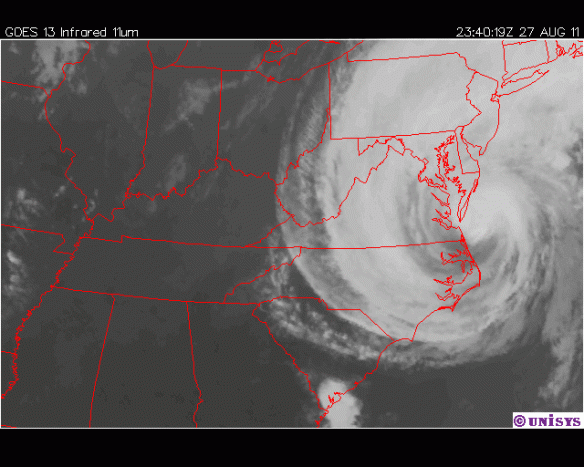
Hurricane Irene - 8-27-2011

So you’re glued to the TV, watching as the “storm of the century” approaches. What to do?

I’m a big believer in knowledge and education but honestly, I try to tune out big media coverage of the storm. Why? Because they do everything they can to hype the storm. The bigger and scarier they make it seem, the more viewers they attract.

I’m going  to take a little different approach than most of these lists. There are hundreds of “hurricane check lists” telling you to fill your bathtub with water and stock up on batteries and food. No, I’m going to give you the practical homeowner tips that nobody else tells you.

Tip #1: Monitor the pure satellite images

My favorite site for no-nonsense satellite images is Unisys weather. Yes, the old-time computer company has the basics. The most informative images are the standard IR (infrared) or the WV (water vapor) image. These images give a great overview of what’s happening on a large scale.

Tip #2: Keep an eye on rivers and streams

The National Weather Service has a great website that few people know about. It has detailed information about projected water levels based on gauges and computations. Here’s a link for the Delaware River gauges in my area. Here’s the national map so you can choose the information for your area.

River levels with projections after Hurricane Irene

Continue reading

April showers bring May flowers, August storms bring…roof leaks!

Summer rains bring flooding

There’s nothing like a gentle Springtime rain. But Summer often brings us torrential downpours, and along with them, roof leaks, incredible moisture and mold!

A few days ago, we had record rainfalls in Eastern Pennsylvania – five inches of rain in some areas. This fortunately came after an extended dry spell, so the rivers didn’t flood this time. We got really lucky.

These heavy rains often bring high winds, fallen branches and roof damage. Sometimes, they’ll just lead to enough leaking for you to notice. Maybe there’s a discoloration on your ceiling or window jamb. Whatever the sign, please pay attention. Failure to deal with a “small” leak now can lead to thousands or tens of thousands of dollars of damage to your house later. Worse, the accompanying mold can pose a severe health/allergy risk.

When dealing with leaks, you need to take several steps in order to minimize the chance of more serious damage to your home:

Continue reading

Ready for some good news?

Kudos MohawkIt’s easy to get dragged down by all the upsetting news – natural disasters, the stock market, wars, terrorism…if you believe the news, we’re living in horrible times, worse than ever before in history.

But step back and think about it. We’re living in a time with a quality of life unimaginable through most of history. Most of us don’t have to worry about famine or disease. Our houses are filled with gadgets that would have been impossible or cost millions of dollars just a generation ago. Our vehicles are cleaner and more efficient than ever. We live in comfort. Our lives are long. Technology and medicine are advancing at an accelerating pace.

I’m a realist, and to me, realism means seeing both the bad and the good in the world. So I started a company, OurKudos, that’s focused purely on the positive. I wanted a place people could go to smile and forget about all the negative “stuff” going on, maybe just for a few minutes. My hope is that, by exposing people to good news, that maybe they’ll get an attitude adjustment. Maybe by learning about the good deeds being done by local heroes, they’ll feel different about the people in their lives and maybe even try to positively change something in their community.

So I bring you the first public showing of OurKudos’ first step into “social good” – OKCheers!


Ted’s Top Tips to Help You Beat the Heat!

Record temperatures are creating uncomfortable conditions all over. Here in Pennsylvania, we’re expecting near 100F temperatures for much of this week, while Chicago just suffered through a heat index of 115F!

Along with high temperatures come big utility bills because of all the air conditioner usage. In this post, I’ll give you some tips for how you can “beat the heat” without breaking the bank!

Why Things Get Hot

If you’ve read any of my posts, you know that I like explaining things because I want you to understand WHY things occur. Once you know why, you can figure out solutions yourself.

Why do we use umbrellas to block the Sun? We all know that it’s cooler in the shade because the sun radiates heat. So if you can block the solar radiation, you can block a lot of the heat that it brings.

Even if you’re in the shade, it can get darned hot! If you’re sitting in your house, you’re being shaded by the roof – no direct sun is hitting you yet you’re still hot. Why? Because there’s still a lot of heat coming in – from the hot roof, the walls, sun shining through the windows and hot air entering the house.

There are other things that heat your house in the summer. Some obvious, some unexpected. You probably know that conventional light bulbs put out a lot of heat. In fact, each light bulb acts like a little space heater. But did you know that every appliance in your home, from your television to your refrigerator, is also pumping heat into the house 24-hours a day? And your water heater, especially if you have an oil boiler for your hot water – those throw off a ton of heat!

Quick recap -houses get hot in the summer because:

  • Solar radiation heats objects in direct sunlight, like your roof
  • Hot air carries heat directly into your house
  • Hot air and solar radiation heat your walls
  • Solar radiation enters through windows and skylights
  • Appliances and lights produce waste heat that enters your home

Beat the Heat!

Now that you know what causes your house to get hot, let’s see what you can do about it. I’ll start with the easy ones and work up to ideas that require more changes or greater investments.

  1. Wear light clothes. Ok, this one is so obvious that I’m embarrassed to write it! But simple things like shorts, a lightweight shirt and no socks make a big difference to your comfort level.
  2. Drink ice water or other no-calorie drinks. Cold drinks help reduce your body core temperature, that’s good. But don’t drink beer or soda or eat ice-cream and expect to stay cold. Anything with calories adds energy to your body, and that energy makes you less comfortable in hot weather.
  3. Use fans to circulate air around you, but only when you’re in the room. Fans cool you by speeding the evaporation of sweat and by carrying heat away from your body. But when you leave the room, turn off the fans or you’ll be wasting electricity AND adding heat to the air because the fan motor gets hot. Remember – fans do not cool the air!
  4. Turn up the temperature on your air conditioner. A slight increase in the temperature setting of your AC results in a significant reduction in the amount it runs. For example, raising the setting from 72 to 76 can reduce the energy use by 25%. Use a fan and turn up the temperature and you’ll see the savings on your next utility bill.
  5. Raise the temperature on your AC when you’re not at home. There’s a lot of debate on this one, but let me put it to rest – you save considerable energy by turning up your AC when you’re not at home. Yes, you have to crank the AC when you get home, but there is definitely a savings – you will save much more energy doing this than leaving the AC at a constant temperature all the time.
  6. Open the windows at night only if it’s cool and dry. Natural cooling at night is a great way to cool the house only when the air is dry. A big use of air conditioning is to remove moisture from the air so if you open your windows at night or in the morning when it’s really humid out, you’re filling your home with water. After that, your air conditioner has to work overtime to remove that moisture. So resist the temptation to open up the house when the humidity is high.
  7. Turn off lights when you’re not in the room. This is always good advice, but it makes even more sense when it’s hot out. Remember, those lights are little space heaters. The longer they burn, the more your air conditioner has to run to remove the heat that the lights put out.
  8. Replace lights with high-efficiency bulbs. This requires a little investment but it pays off year round. Compact fluorescent and LED bulbs are much more efficient than conventional bulbs mostly because they convert more of the electricity into light. I’ve written more than enough about the direct energy savings from these bulbs. Stop making excuses and replace those bulbs!
  9. Install a new fridge. And recycle your old refrigerator. The old energy hogs throw off an amazing amount of heat. A new, super-efficient fridge can pay for itself in a few years and it will heat your house less.
  10. Add insulation to your attic. If you don’t have at least a foot of insulation in your attic, you’re probably under-insulated. If you have a house from before the 1980’s, chances are, you only have a few inches of insulation. Going from 3 inches to the recommended 14″ of insulation (maybe R-9 to R-42) will reduce the amount of heat moving from your attic into your home by about 80%. A good insulation job is something you’ll appreciate year round.
  11. Shade your windows. Remember, a big reason things get hot is because of sunlight. Ideally, you don’t want direct sunlight entering the windows. The best way is by using trees or bushes to shade the windows. If that’s not possible, exterior awnings do a great job, though many people object to the aesthetics. If that’s you, then get interior cellular shades to block the direct light.
  12. Get windows with heat reflective coatings.  In recent years, window coatings have gotten truly amazing. A good window can block 90% of the heat from entering from the sunlight. This also protects your carpets from damaging UV radiation. An added benefit is that these same windows will hold in more heat during the winter and they’ll be less drafty. So replacing old, leaky, single-glazed windows with tight, low-e, double or triple-glazed windows can make a big difference in your comfort year round.
  13. Install a white-roof. Depending on your climate and your current insulation, this may or may not make sense. If you have lots of insulation, than the amount of heat coming in from your roof can make very little difference. But if you’re changing your roof anyway, get a reflective roof. This can substantially reduce attic temperatures and therefore the heat entering your home.
  14. Install a more efficient air conditioner. New air conditioning is usually my last recommendation. You’ll spend thousands of dollars and depending on where you live, you’ll may only use it a few months per year. However, if you have an old unit, it’s probably operating at less than SEER 10, so switching to a new SEER 18 unit can cut your AC bills nearly in half.

Swimming Pools: Save Energy While Enjoying the Summer Heat

Is there an Energy Hog in your pool?


If you have a swimming pool, you probably hate to see your utility bills during the summer. Chances are, you’ve attributed the high bills to your air conditioner. But pools and their associated pumping equipment might be responsible for at least as much energy use as that big central air conditioner!

Why does the pool use so much electricity and is there anything you can do about it?

Pumping water takes a lot of energy. Just think about the last time you took a swim. It takes all your energy to swim the length of the pool, while you could walk this distance without difficulty. In the same way, moving water, because of its weight and resistance to flow, requires a lot of energy.

So if moving water naturally takes energy, how can you reduce the consumption?

Without getting too technical, moving a gallon of water through pipes takes much less energy if it is moved slowly than quickly because of water turbulence. Just knowing this allows you to dramatically reduce your pool pump’s energy use.

Unfortunately, most pools are designed with vastly oversized pool pumps. For example, my pool had a 1.5 horsepower (HP) pump. This is useful for backwashing the filter, but for general filtering, using such a huge pump results in less efficient filtering and much more energy consumption. Worse, that 1.5 HP pump might pump less than twice as much water as a .5 HP pump due to the high turbulence caused by the larger pump.

You’ll find that running that 1.5 HP pump for 10 hours a day (fairly common for pool pumps) will add about 15 kilo-Watt-hours to your electric usage. For many households, that’s an increase of 30%-50% of the home’s total daily electric consumption! Over the course of a summer, that adds up to hundreds of dollars in increased electric bills.

For my pool, I installed a two speed pool pump that allows me to run at 3/8 HP for general filtering. The water flow is ample for filtering yet it uses about 1/8th the electricity as when it runs at 1.5 HP. The only time I turn it on ‘high’ is when I’m backwashing the filter. Other than that, it runs 12 hours per day at a few hundred Watts (a total of about 3.6 kWh/day). When I convert kWh/day savings (over 10 per day) to dollars, I’m saving more than $1.60/day which is about $150 per summer in saved electric bills.

If you’re building a new pool or replacing an old pump, installing a multi-speed or variable speed pump is a no brainer. At a cost of about $500 for a high end two-speed pump or $1000 for a variable speed, the savings will pay for the pump in a 3-6 years. About half that if you’re replacing an existing pump and would have to buy a new pump anyway. Pu another way, that’s like having an investment that pays 15%-30% dividends – in these economic times, you’re not going to find a better investment!

Your specific numbers will vary depending upon your electric rates. I pay a lot in eastern Pennsylvania, so any electric savings pays back quickly. If you’re in an area with cheap electricity, the payback won’t be as quick.

Preparing your home and air conditioner for summer

Summer has arrived and you’ve probably already used your air conditioner. But how do you know it’s working at maximum efficiency?

Unfortunately, it’s not easy to tell if your AC is running at full spec. Even many professionals have difficulty squeezing out every last percent of efficiency, but you can certainly figure out whether there are big problems with your system.

  • Start with the easy stuff and replace the air filter(s) if they’re not really clean. The more restriction to the air flow, the less efficiently the system will operate.
  • Make sure you have an air tight cover on your filter port if the filter is one of the types that slide into your air handler’s housing. Why? If your air handler is in the attic and you leave that open, you can be losing 30% or more of your efficiency because of all the hot air that it sucks in through that opening.

Evaluating your cooling system performance

Next, run your air conditioner for a while, at least 20 minutes, so that it’s good and cold. Turn your thermostat down to 60F so that it will run continuously. You’re going to run some simple tests to see how the system is performing.
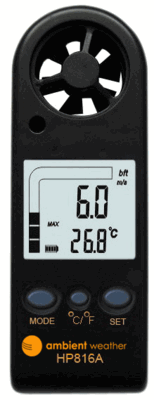
You’ll want to purchase an inexpensive air-speed and temperature gauge like this one. It’s well worth the investment as it lets you do basic troubleshooting on your system and can save you hundreds of dollars in diagnostic charges.
  • Measure the air speed and temperature at each of the vents, placing the unit right on the air register. The main thing is to be consistent in placement. Let it measure until the temperature stabilizes.
  • Also measure the air temperature going into your system. If you have a central air return, this is easy. You just need a general measurement of temperature. Usually this will be around 75F.
  • For each air output, with a typical system, you should measure the temperature of the cool air at about 20 degrees cooler than the air going into the system. That’s called the “temperature drop.” This number varies a fair amount, but if it’s less than 15F or greater than 25F, you probably have a problem with the system.
  • Get a feel for the amount of air coming out of each of the register. It should be a pretty good flow. If you find any that are much less flow than others, make a note of that. That could mean that a duct is detached or it might be shut off with a damper.
  • It’s also a good idea to note any rooms that don’t seem to be getting cool. There are a number of things that could cause this – insufficient cold air flow, poor insulation, solar heating through windows, hot air leaking into the room and so on. Try to determine the cause and make a note of this. For example, if the room isn’t on the sunny side of the house and the cool air flow seems good, you’ve probably have bad insulation or a big leak of hot air from the attic.
Making lists of the various symptoms you have is a good way to track down the big issues that are wasting your cooling dollars.

Check for hidden duct leaks

If you’re lucky, you can check your house for hidden duct leaks. It’s pretty simple.

  • Make sure all the windows and doors are closed tight and latched.
  • Check fireplace dampers to ensure that they are closed too.
  • Turn on all the bath fans, if you have any
  • Turn on the kitchen or range fan if it vents to the outside. If you’re lucky enough to have a Jenn-air range with blower, you’ve got access to a really great blower that’s perfect for this test!
  • Turn OFF the air conditioner and its fan. It may take several minutes for the blower to turn off.
The goal here is to be blowing air out of the house and create a negative pressure inside the house, meaning the house wants to suck air in through any leaks to the outside.
Now, you look for leaks!
  •  Just as you did before, check all the air conditioner vents. Since the AC is turned off, there should be no air coming out of them.
  • If there is any air coming in the vent, it means the duct system is leaking air to the outside.
  • Often, upstairs ductwork runs through the attic, and any air leaks there will pull very hot attic air into the house. These will be the easiest to find.
  • Make note of any vents that seem to be blowing hot air. The more air that comes in the vent, the closer the vent is to the leak.
  • If you find a particularly leaky vent, you might want to remove the vent and look in. I have found many that aren’t connected to the ceiling so you can see right into the attic! Or, the duct might have fallen off. A little detective work can go a long way.

What about the main unit?

So far, we’ve done things that you can do yourself to track down problems. But some things need to be done by a pro.

In general, if the system is delivering sufficient air to all the rooms and it’s about 20 degrees cooler than the air in the house, you’re probably in good shape. It still wouldn’t hurt to have the system checked out yearly, but honestly, what you’ve done so far enough to find the significant issues.

If you do find that the system isn’t cooling the air properly and you’re sure the air flow is good, then you should probably get the system checked out. But beware! If you have an AC contractor come out and he (they’re almost always male) says he need to “top it up with a pound or two of freon”, send him packing! AC systems never have to be “topped off” – they are “closed systems” so they should never use up their refrigerant (i.e. freon). Worse, these hacks can cost you hundreds or thousands of dollars in unnecessary repairs because adding too much refrigerant will damage your compressor and cause your system to run inefficiently.

One of the signs of an over-charged system is insufficient cooling of the air. So, in fact, I trust a technician far more if he says that the system is over-charged. But really, the proper way to evaluate the system is by doing a set of measurements on the refrigerant pressures and temperatures. With proper tests, they should be able to tell if there’s a problem with the system and, if so, what it is.

If your system does actually have a leak, it has to be fixed. You should not just add refrigerant because that will leak out and, if the system loses too much, you could end up having to replace the compressor. So make sure they track down the leak and fix it properly! With the proper equipment, most leaks are very easy to find.

This should get you started with your summer preparation. Stay cool!

Even an Energy Auditor can get Bitten by an Energy Hog

I am embarrassed! I was recently bitten by an “energy hog” – an unwanted waster of energy hiding in the deepest recesses of my home.

He snuck in last week while I was using a lot of energy for opening/cleaning my pool. You see, at that time, I was running a big pool pump 24 hours a day, so naturally, my daily electrical usage increased. But I didn’t expect it to increase so much!

As part of the pool cleaning, you have to flush out a lot of water to clean the filter. Then, you have to add hundreds of gallons of water back into the pool. Since I’m on well water, that means running the well pump a lot! And if you’ve read my other articles, you know that pumps are notorious for using lots of energy. So the combination of the pool pump plus two well pumps adds up to big energy use. Continue reading

YALEDLB – Yet Another LED Light Bulb! Philips 75W Replacement!

Great news for all us energy geeks! Now Philips has an LED bulb that puts out 1100 lumens – in technical terms, that’s a bucket load of light! For comparison, most of the other screw-in LED lights I’ve been commenting on put out the equivalent of a 40w-60w light bulb, maybe 600-800 lumens. For more info, see this press release on Engadget.

Note, the Engadget folks were WAY off in the lifetime. These bulbs last 25 times as long as a conventional bulb (as shown in the press release).