Unknown's avatar

About T.D. Inoue

Ex-digital imaging entrepreneur, Green building advisor, professional problem solver. Amateur chef. Avid ice cream maker and general troublemaker

Videos on insulating and sealing a crawlspace

Here’s a handy, albeit highly incomplete, video on insulating your crawlspace:
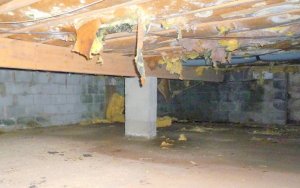
Insulation installed upside-down

The positives:

  • They installed it with the vapor barrier put firmly up against the floor of the room above – this is actually correct. Most people install it upside-down and staple the paper vapor to the floor joists – this is totally incorrect. When you do that, you end up with moldy insulation like shown here.
  • They stressed the importance of air sealing and even showed the band joists (technically called the “rim joist”). Kudos for that!

The not-so-good:

  • They noted the importance of installing a vapor barrier on the floor, though they should have mentioned that you typically only do that for a dirt floor. They should also have mentioned that just laying plastic on the floor won’t do much to stop moisture from coming up. Any place air can flow, water vapor will go!
  • They used fiberglass (of course) on the rim joists. Unfortunately, this can lead to moisture damage. See this excellent article in Fine Homebuilding (PDF file) on insulating the rim joist.

Superb video on a crawlspace sealing system

The next (commercial) video presents the situation in crawlspaces accurately and proposes a solution that appears to be done thoroughly and professionally. Note that I have no personal experience with the company that produced the video. Regardless, it is well worth a view.

___________________

Here’s a very nice article on insulating your crawl space by the Dept. of Energy. They get the rim joist insulation wrong though…

Fine Homebuilding article showing the proper way to insulate the rim joist.

Family Handyman article on installing a vapor barrier in your crawlspace.

Types of insulation: part 3-Insulations compared

Signs of moisture and air flow in fiberglass insulation

When you climb into an attic and see this, you know something is seriously wrong. In fact, if your home isn’t very old, your insulation should be clean like when it was installed. The reason you get black insulation like this is because air and moisture are moving through the insulation, and it’s acting like an air filter.

The reason I’m showing you this picture is because it’s an example of the wrong insulation being used for a job. I feel pretty strongly about this because I’ve seen numerous homes where fiberglass has been installed in open walls like this and in almost every case, the insulation was seriously compromised – it was buckling under its own weight or simply falling out of the wall cavity. Or, in cases like this, it was hiding a big hole in the wall that should have been air sealed.

Let’s walk through the different insulation types and compare their main attributes: R-value, ability to reduce air movement, suitability for retrofit applications, and other characteristics.

Continue reading

Building Science vs. B.S.

This video is a promo for my upcoming video series, Building Science vs. B.S.

You hear B.S. every day….

***B.S.***

houses need to breathe
too much insulation causes roofs to rot
furnaces dry out your house
cold water boils faster than warm water
green building is always more expensive
ridge vents always help cool your roof and reduce moisture

***B.S.***

Unfortunately, B.S. like this gets spread by supposed experts, further perpetuating these damaging myths.

The problem is, people are really bad at reaching proper scientific conclusions. Our brains are wired to look for patterns, and research has shown that we create patterns where none really exist. For example….

  • Did you ever buy a new car, then suddenly notice that model everywhere?
  • If you’re a woman who has been pregnant, didn’t it seem like there were lots more pregnant women around?

It’s called “perceptual vigilance” and it leads to all sorts of incorrect conclusions. It causes people to think something in their environment has changed, while in fact, it is only their brain that changed!

There’s another favorite term among scientists: “correlation is not causation.” This is a related cousin to perceptual vigilance. What they’re saying is that just because two events appear to be correlated, it doesn’t mean that one caused another.

Insulation  does not cause roofs to rot!

Let’s start with a simple piece of B.S., usually spread by poorly informed contractors.

Continue reading

Guest post: How I dealt with water problems and saved the house

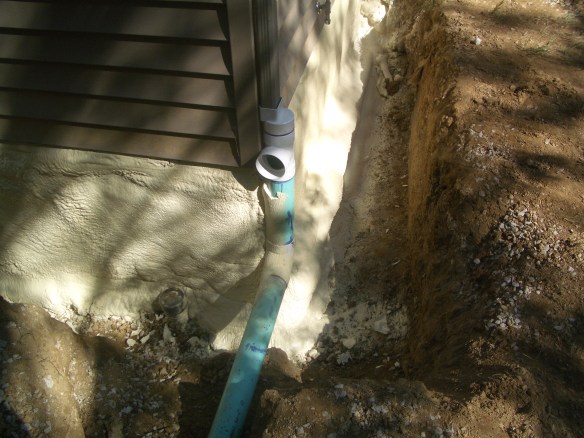
Crawlspace walls after foaming

My good friend Jerry takes to the keyboard today, telling us the trials and tribulations of having a house adjacent to a hill….

__________________________

We bought the house not knowing the backyard had really bad water retention issues (note: never buy a house when there’s snow covering the yard).  After heavy rain in the spring, the back yard would essentially be an unmowable mudpit for several weeks.  We had French drains installed which greatly alleviated the issue.  With the remodel, we figured we’d further address the wet yard by channeling the downspouts from the gutters in the back of the house into an underground collection pit (a dry well), which would run off into a rocky bed leading to the street.  This also worked well.

Unfortunately, during construction they built an open crawlspace under what would later become the kitchen extension.  Open to the sun and the stars…and the rain.  The first rain after they built it happened on a weekend.  The carpenter/job manager came over without us even calling, luckily, and build a makeshift cover out of plywood.  But it was a heavy rain and we had to run and get a pump as well to keep the crawlspace from filling up and coming into the basement.  Eventually they built the kitchen over it, and that was the end of that.  Or so we thought.

The Energy Geek Video 2: LED Recessed Light Retrofit

A lot of people ask me about recessed lights, so I put together this video so you could see some of the pros and cons of the best LED light I’ve ever seen.

The CREE LR6, LED based recessed light retrofit is the current one to beat. It’s simply amazing. It turns on instantly, it supplies high quality light and it’s built like a tank. Watch the video for the full scoop!

*Update: 3/13/2011*

After reading some other reviews, I decided to purchase several CREE CR6 retrofits. You can get them on the Home Depot website for $50 and they’re supposed to be dimmable down to 5% as opposed to 20% for the CR6. So there’s some hope for a good dimmable retrofit bulb.

I’ll do another video comparing the two once I’ve had a chance to play with the CR6.

CREE also has a number of other new lights that I wasn’t aware of. The new LR6 puts out 50% more light for the same amount of watts for a luminous efficacy of 80 lm/W

Other posts and sites covering the Cree LR6

Consumer Reports – preview of the CREE CR6

CREE 6″ downlights page – The official CREE page on all their downlight products. Dimmable to 20%

CREE CR6 page – The official CREE page on the CR6 “low cost” LED light. Dimmable to 5%.

CREE LR6 page – The official CREE page on the LR6. Dimmable to 20%

Dave Hultin blog post – The CREE LR6 – A Beautiful Light!

Dave Hultin blog post – The CREE LR6 – It Really is That Good!

GreenTex Builders – Commercial builder’s perspective on the CREE LR6

House+Earth – LED Lighting – CREE LR6 & CR6 Can Lights

Inside Solid-State Lighting – CREE LR6 Downlight Replacement

Ranch Remodel – A real homeowner’s blog about remodeling their ranch with CREE LR6 lights


Types of Insulation: Part 2 – Where does insulation go?

In part 1 of this series, I gave you an overview of the different insulation materials and the various forms they come in. This article covers where insulation goes and why. Knowing this helps you understand why you’d want to use a particular type of insulation for specific applications in your home.

Where do you use insulation?

  • On the attic floor
  • In attic cavities
  • On an attic knee wall
  • On the attic ceiling
  • In the walls
  • Around the windows and doors
  • Around pipes and other holes in the wall
  • In the basement and crawlspace ceilings
  • On the basement and crawlspace walls
  • Under the slab
  • Outside the foundations

Each of these areas really deserves an article of its own. In fact, if you look on the Building Science website, you’ll find highly detailed articles doing exactly that.  If you want to go straight to the source, consult these references.

Let’s look at some photos to get an idea of several of these cases…

Continue reading

The Energy Geek Video: Sun Tubes and Skylights

My first Energy Geek video! This is the companion video for the recent article on Sun tubes.

Don’t expect much production quality. These videos will be like this blog – unedited, not politically correct, lots of opinions. So if you’re expecting “This Old House” you better look elsewhere!

——

FAQ for Solatubes

Q&A – Types of Insulation

Bonded Logic Denim Insulation

When you insulate your house, you’re going to be confronted by a dizzying array of choices. How do you know which one to use? How much do they cost? Are some better than others or is it all hype? In this article, I’m going to do my best to sort through the options and help you make sense of them. Be warned – there’s a LOT of material here, so I’m going to have to break this into several articles.

First, let’s survey the types of insulation that you’re likely to encounter. I’m also going to provide links where appropriate.

  • Fiberglass – batts
  • Fiberglass – dense batts
  • Fiberglass – compressed
  • Fiberglass – shredded / loose fill
  • Fiberglass – Johns Manville Spider – sprayed in
  • Cellulose – loose fill
  • Cellulose – damp sprayed in
  • Cellulose – dense packed
  • Spray foam – open-cell, Icynene
  • Spray foam – open-cell, soy based
  • Spray foam – high-density closed-cell
  • Spray foam – high-density closed-cell, soy based
  • Board foam – expanded polystyrene
  • Board foam – extruded polystyrene
  • Board foam – polyisocyanurate
  • Board foam – foil faced polyisocyanurate
  • Denim – Bonded Logic batts

This list is long enough. There are other insulation materials that have been used over the years, from vermiculite to horse hair to rice hulls to straw bales, but I’m not going to touch on anything that isn’t commonly available in the United States. Sorry!

Insulation Characteristics

Before we go into analyzing all the details of insulation materials, let’s spend a moment defining the basic characteristic of insulation – the R-value.

Continue reading