
Ted’s Top Tips to Help You Beat the Heat!

Record temperatures are creating uncomfortable conditions all over. Here in Pennsylvania, we’re expecting near 100F temperatures for much of this week, while Chicago just suffered through a heat index of 115F!

Along with high temperatures come big utility bills because of all the air conditioner usage. In this post, I’ll give you some tips for how you can “beat the heat” without breaking the bank!

Why Things Get Hot

If you’ve read any of my posts, you know that I like explaining things because I want you to understand WHY things occur. Once you know why, you can figure out solutions yourself.

Why do we use umbrellas to block the Sun? We all know that it’s cooler in the shade because the sun radiates heat. So if you can block the solar radiation, you can block a lot of the heat that it brings.

Even if you’re in the shade, it can get darned hot! If you’re sitting in your house, you’re being shaded by the roof – no direct sun is hitting you yet you’re still hot. Why? Because there’s still a lot of heat coming in – from the hot roof, the walls, sun shining through the windows and hot air entering the house.

There are other things that heat your house in the summer. Some obvious, some unexpected. You probably know that conventional light bulbs put out a lot of heat. In fact, each light bulb acts like a little space heater. But did you know that every appliance in your home, from your television to your refrigerator, is also pumping heat into the house 24-hours a day? And your water heater, especially if you have an oil boiler for your hot water – those throw off a ton of heat!

Quick recap -houses get hot in the summer because:

  • Solar radiation heats objects in direct sunlight, like your roof
  • Hot air carries heat directly into your house
  • Hot air and solar radiation heat your walls
  • Solar radiation enters through windows and skylights
  • Appliances and lights produce waste heat that enters your home

Beat the Heat!

Now that you know what causes your house to get hot, let’s see what you can do about it. I’ll start with the easy ones and work up to ideas that require more changes or greater investments.

  1. Wear light clothes. Ok, this one is so obvious that I’m embarrassed to write it! But simple things like shorts, a lightweight shirt and no socks make a big difference to your comfort level.
  2. Drink ice water or other no-calorie drinks. Cold drinks help reduce your body core temperature, that’s good. But don’t drink beer or soda or eat ice-cream and expect to stay cold. Anything with calories adds energy to your body, and that energy makes you less comfortable in hot weather.
  3. Use fans to circulate air around you, but only when you’re in the room. Fans cool you by speeding the evaporation of sweat and by carrying heat away from your body. But when you leave the room, turn off the fans or you’ll be wasting electricity AND adding heat to the air because the fan motor gets hot. Remember – fans do not cool the air!
  4. Turn up the temperature on your air conditioner. A slight increase in the temperature setting of your AC results in a significant reduction in the amount it runs. For example, raising the setting from 72 to 76 can reduce the energy use by 25%. Use a fan and turn up the temperature and you’ll see the savings on your next utility bill.
  5. Raise the temperature on your AC when you’re not at home. There’s a lot of debate on this one, but let me put it to rest – you save considerable energy by turning up your AC when you’re not at home. Yes, you have to crank the AC when you get home, but there is definitely a savings – you will save much more energy doing this than leaving the AC at a constant temperature all the time.
  6. Open the windows at night only if it’s cool and dry. Natural cooling at night is a great way to cool the house only when the air is dry. A big use of air conditioning is to remove moisture from the air so if you open your windows at night or in the morning when it’s really humid out, you’re filling your home with water. After that, your air conditioner has to work overtime to remove that moisture. So resist the temptation to open up the house when the humidity is high.
  7. Turn off lights when you’re not in the room. This is always good advice, but it makes even more sense when it’s hot out. Remember, those lights are little space heaters. The longer they burn, the more your air conditioner has to run to remove the heat that the lights put out.
  8. Replace lights with high-efficiency bulbs. This requires a little investment but it pays off year round. Compact fluorescent and LED bulbs are much more efficient than conventional bulbs mostly because they convert more of the electricity into light. I’ve written more than enough about the direct energy savings from these bulbs. Stop making excuses and replace those bulbs!
  9. Install a new fridge. And recycle your old refrigerator. The old energy hogs throw off an amazing amount of heat. A new, super-efficient fridge can pay for itself in a few years and it will heat your house less.
  10. Add insulation to your attic. If you don’t have at least a foot of insulation in your attic, you’re probably under-insulated. If you have a house from before the 1980’s, chances are, you only have a few inches of insulation. Going from 3 inches to the recommended 14″ of insulation (maybe R-9 to R-42) will reduce the amount of heat moving from your attic into your home by about 80%. A good insulation job is something you’ll appreciate year round.
  11. Shade your windows. Remember, a big reason things get hot is because of sunlight. Ideally, you don’t want direct sunlight entering the windows. The best way is by using trees or bushes to shade the windows. If that’s not possible, exterior awnings do a great job, though many people object to the aesthetics. If that’s you, then get interior cellular shades to block the direct light.
  12. Get windows with heat reflective coatings.  In recent years, window coatings have gotten truly amazing. A good window can block 90% of the heat from entering from the sunlight. This also protects your carpets from damaging UV radiation. An added benefit is that these same windows will hold in more heat during the winter and they’ll be less drafty. So replacing old, leaky, single-glazed windows with tight, low-e, double or triple-glazed windows can make a big difference in your comfort year round.
  13. Install a white-roof. Depending on your climate and your current insulation, this may or may not make sense. If you have lots of insulation, than the amount of heat coming in from your roof can make very little difference. But if you’re changing your roof anyway, get a reflective roof. This can substantially reduce attic temperatures and therefore the heat entering your home.
  14. Install a more efficient air conditioner. New air conditioning is usually my last recommendation. You’ll spend thousands of dollars and depending on where you live, you’ll may only use it a few months per year. However, if you have an old unit, it’s probably operating at less than SEER 10, so switching to a new SEER 18 unit can cut your AC bills nearly in half.


How to Increase the Energy Efficiency of Your Existing Home

This post by an energy auditor in central PA summarizes a lot of the information required to make your home more energy efficient, all in one spot. It’s like you took all my posts to date and wrapped it up into a single article! Definitely worth a skim.

For those of your unfamiliar with ChrisMartenson.com, Chris is a scientist who, several years ago, started investigating peak-oil – the fact that at some point, you can’t extract oil from the Earth any faster, and from there, it’s downhill. As he investigated it, he got more and more worried, because pretty much everything we do depends upon having essentially an unlimited supply of oil.

Chris is passionate about this cause. So passionate that he produced a series of videos and is traveling the world giving lectures about how to prepare. At first it seems nutty, especially if you’re of the mindset that “technology will always find a solution”, but if you listen carefully and do your own research, you may find yourself buying in to what he says.

I started following him a few years ago, and combined what he said with what I learned from various investment newsletters and other sources. That gave me an advanced warning to shift from classical stocks into metals and mining a few years ago, before the market tanked and mining stocks skyrocketed.

Whether you agree with him or not, his “Crash Course” is well worth viewing as it provides additional insights that you can use to better understand the complex, resource limited world in which we’re now living.

The Sustainable Building Advisor Institute

It’s been a busy week for me with my startup, OurKudos.com, so I haven’t had much time to contribute to Ted’s Tips. But now on a rainy Friday night, I feel the need to decompress and talk about energy efficiency and sustainable building again!

I got an announcement today from the Sustainable Building Advisor Program, an organization dear to my heart. They have changed their name to the Sustainable Building Advisor Institute and launched a new website.

Why is this so exciting? The SBA program is a wonderful organization dedicated to training people in the world of sustainable building. Unlike so many organizations that have sprung up in the last few years simply to make a buck on the “green” excitement, the SBAi is truly about the teaching. It’s a very small organization of dedicated individuals, passionate about what they do.  Continue reading

Ultimate attic insulation

Icy roof deck, not a good sign!

In the first two posts of this overly wordy series, we saw a few ways to insulate an attic while avoiding some of the worst problems that can lead to moldy, rotten attics and roofs.

If you recall, the big problem is that moisture from the house rises up through the walls and all the little cracks around light fixtures, hatches, wiring, and the moisture condenses on cool surfaces. Over time, this will lead to mold growth and potentially, rotten roofs.

How do you know if you’ve got a problem? I’ll give you a hint – if you have ice forming under your roof like in this picture, you had better do something before you have to replace your roof!

Continue reading

Building Science vs. B.S.: Radiant barriers – the perfect insulation?

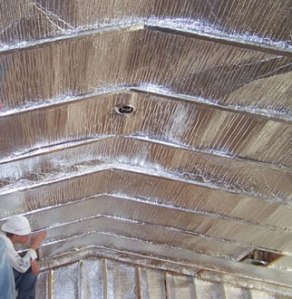
An attic radiant barrier application

Before I dive into another couple thousand words on attic insulation, I thought we’d take a break and talk about an energy saving miracle product!

What if there was an insulation product that was light, cheap, easy to install, and gave an incredible R-value?

If you believe the advertising, then radiant-barrier bubble wrap insulation is this ‘miracle’ insulation. In that advert, they claim an R-value of 15.67 for a quarter inch thick piece of aluminum coated bubble wrap! Wow, that’s over R-60 per inch! All our insulation problems are solved!

Continue reading

The best way to insulate your attic – part 2

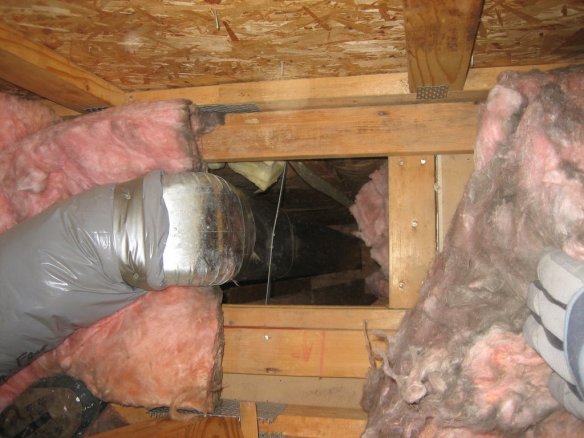
Wow, where's that hole go?

In the first installment on attic insulation, I discussed why it can be dangerous to add insulation to your attic without air sealing the attic floor first. Moisture can slip through tiny cracks in the attic floor and lead to rotten roofs. Given this information, we walked through the process of finding and sealing all those insidious air leaks in your attic, some easy, some difficult. But finally, after fixing all these problems, you could lay more insulation down on your attic floor, more confident that doing so wouldn’t lead to a humid, moldy attic.

But what if there’s an easier way?

Whether you’re building a new house or retrofitting an older one, you can make life much easier on yourself by using professionally applied spray foam insulation that air seals and insulates in one shot. There are two ways of doing this, each with their own benefits and disadvantages. We’re going to review both methods. One is spraying foam on the attic floor, instead of using loose fill or batt insulation. The other is spraying foam under the roof deck. Continue reading

What’s the best way to insulate your attic? or How I learned to think like a child

U.S. EPA Air infiltration poster

Many of my posts come back to air sealing and insulating the attic. Why is that?

If you’ve done any searching about home weatherization, insulation, energy efficiency or related topics, you’ve probably come across the picture shown above. And for good reason – it clearly shows all the common sources of air leaking into (infiltration) and out of (exfiltration) your home.

One subtle part of the picture is that the size of the arrows represents the relative amounts of air leakage from each location. See all those big orange arrows going up into the attic? Those tell you that large amounts of warm air from your house leak into the attic during the winter. This is why all us energy geeks keep spouting about the importance of sealing up the attic before you waste you time on things like replacement windows, sealing electrical outlets, and so on. You can spend thousands of dollars and countless weekends working on all these other areas and it probably won’t improve your home’s energy efficiency as much as just focusing on your attic.

Continue reading

What does it mean if your fiberglass insulation is black?

Insulation filters the air leaks from your house, showing you signs of energy loss

You might have noticed some black insulation in your attic or maybe around the perimeter of your basement, where the house rests on the foundation. What does this mean? Is it moldy? Wet? Why is the insulation black?

In fact, black insulation is the energy auditor’s best friend because it tells us where the problems are. In just a few minutes of looking around the attic, you can find the most serious air leaks from the house. Here’s why…

Continue reading

How to prevent your boiler from stealing your money

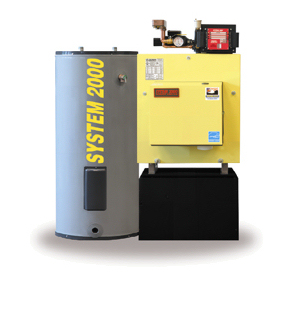
Energy Kinetics System 2000

Energy Kinetics System 2000

In the last article, “Is your boiler stealing your money?“, I discussed why most boilers are ripping you off. Contrary to what almost every HVAC saleperson or tech will tell you, your boiler does not operate at 84% efficiency. It doesn’t operate at 80%! Heck, much of the year, it doesn’t operate at 50% efficiency!

To review, the reasons for this include:

  • High operating temperature
  • Minimal insulation
  • Infrequent use
  • → Outrageously high standby losses

In this article, I’m going to discuss how to do it right. But if you’re too lazy to read the entire article, stop right here and go to the Energy Kinetics website.

But first, I’m going to save you $10,000….

Continue reading

Home Energy Magazine

If you like this blog, then you’ll really like Home Energy Magazine!

Here’s their promo for the latest issue:

If there’s one thing contributing editor Steve Mann learned while attending the 2010 Passive House Conference in Portland, Oregon, it’s that the Passive House approach is anything but passive. In this issue of Home Energy, Steve explains the history of the Passive House standard, where it stands today, and what its future holds. Steve is a HERS rater, Green Point rater, LEED AP, Certified Energy Analyst, serial remodeler, and longtime software engineer.

Read the excerpts below to learn why senior building science consultant John Tooley says we need to Raise the Bar for Home Performance, and how a standard retrofit package can save a homeowner money in The Robo Retrofit House. This issue also features real-life horror stories from the field of energy auditing and a look into how students at Syracuse University experienced a Multifamily Performance Program in on-campus housing.

Click here to access the current issue. If you are a current online subscriber to Home Energy, click here to log in.