Retrofit your attic hatch for improved comfort and energy efficiency

Link: Retrofit your attic hatch for improved comfort and energy efficiency

Thermal image of leaky attic hatch

The typical attic hatch is drafty and improperly insulated. Fixing it can reduce the energy loss of a room by half. This afternoon project is simple and cost effective providing results you can enjoy year-round.

If you’re looking for the best commercial product on the market, check out the Energy Guardian attic hatch covers from ESS Energy Products. They’re by far the nicest product I’ve seen for this application.


Got Mold? Part 3 – a flood doesn’t have to be the end of the world

By now, you’re probably terrified of water, and well you should be – it is a silent destroyer of homes. On the other hand, I don’t want anybody freaking out because they spilled a bucket or even a glass of water on the floor!

Mold doesn’t grow instantly. It needs time, water, and sometimes warmth. I’ve seen plenty of cases where people have had a serious flood in their homes – perhaps a toilet or sink flooded a bathroom, but these resulted in no mold. Why? Because the water was cleaned up quickly and everything was allowed to dry out.

The danger is when you let water or condensation get trapped somewhere. For example, I see this a lot – house-plants causing rotten wood, like shown above. There was a huge house plant sitting in a plastic pot. The pot didn’t leak, but periodically, somebody might spill a little water which would go under the pot and get trapped. Over time, it totally ruined the oak floor.

Trapped water is bad. Water left to evaporate is usually harmless.

Most of the mold and water damage I’ve seen occurs over a long period. Weeks, months or even years of neglect. So it usually isn’t a surprise when you find problems. However, like the proverbial slowly boiling frog, we often ignore a “little” condensation or a puddle of water. But, these are exactly the things that cause you to wake up one day and find that your window sash has rotted out.

A little moisture over a long period can cause serious damage.

Let’s look at a few scenarios and classify them as bad or not-so-bad.

Scenario 1:

Your toilet or sink overflows, but you catch it quickly. Maybe a couple buckets worth of water floods your bathroom.

First off, any time you have a water spill, the first thing to do is to clean up all the water (duh)! If you have a wet-use shop-vac, you can put it great use. Shop vacs do a wonderful job of cleaning up spills because they’ll suck the water off the floor and out of nooks and crannies. If you don’t, then use a sponge mop and soak up all the water.

When you’re done with the bulk of the cleanup, use an old towel to dry everything as well as you can.

Often, this simple cleanup will be enough if you catch the leak before it has a chance to really soak in. So beyond this, just run the bath fan for a few hours to flush out the moisture in the air or run a big floor fan in the doorway. 

All told, this type of “water event” can be pretty harmless. 

Scenario 1a:

You flood the bathroom with enough water that it drips out the ceiling or light fixtures in the floor below. 

This could mean trouble. In most homes, you have the finish flooring, with a wood sub-floor underneath. This sits on the floor joists. Underneath, the ceiling material, usually sheet-rock, is nailed or screwed to the underside of the joists. If the water flooded down to the floor below, that means that a substantial amount is likely in this space around the floor joists which you can’t get to in order to dry it out.

As in scenario 1, you want to immediately clean up the water above. Forget the floor below (yet) – stop the water above from coming down! If you clean up the water and get the bathroom drying out, that will help the water evaporate and allow all the building materials to dry out. Remember – water “wants” to move from wet to dry areas.

However, your work isn’t done yet. There’s a good chance that your sheet-rock will pull away from the nails/screws that hold it up. When it gets wet, sheet-rock will turn to mush. Don’t touch it or you may destroy it. You also run the risk of having the ceiling collapse on your head.

The best thing to do is clean up all the visible water from the bathroom and the floor below and then put dehumidifiers in both rooms. Let them run for a couple of days. You literally want to suck the moisture out of the building materials as fast as possible.

If you’re a professional and have good toys, you can use a moisture meter. I have a few of these. They let me scan behind walls and ceilings without having to take everything apart. There are two types – the pin type, which is generally more accurate but requires that you stick the probes into the material, and non-destructive, which works on the electrical properties of the material which change with water content.

The problem is, if you don’t have one of these meters, you really don’t know how much water remains in the ceiling cavity. If that water isn’t totally dried out quickly, you’ll probably have mold growing in there. You will be very unlikely to have wood rot however because the water will get soaked up and evaporate over time so the conditions for continued mold and related problems decreases over time.

The question is, if you do get a little mold in there, is that a problem?

Before I answer, if you have any doubts whatsoever about you or your own family’s sensitivities to mold, contact a professional. Without actually examining your home, there is no definitive information that anybody can give you. In other words, if you choose not to have a professional evaluate your problem and your house collapses or you die of mold allergies – don’t blame me!

There is a school of thought that as long as you get rid of the water let the mold grow in the first place, you don’t want to mess with it, especially if it’s safely trapped in the walls or ceiling.

What would I do? When I’ve had situations like this in my own home, usually after I’ve dried things out, I will cut a hole in the ceiling – maybe 16” square. Large enough to poke my head into and check things out. Sheet-rock is easy to patch, and you’re better safe than sorry. Though now that I’ve got those excellent moisture meters, if they indicate that it’s dry in there, I don’t worry about it.

Scenario 2: 

You’ve had a flood that you didn’t discover for a couple weeks.

This is bad news, really bad. I’ve seen homes totaled by this. Seriously.

This typically occurs when a pipe bursts in a vacation home. Or a rat chews through the water lines of your dishwasher or washing machine. The water pours out, gallons every minute, for the entire time. It’s horrible. Thousands of gallons flooding into every corner of the house, soaking into the carpets, up the walls, into every cavity.

In a situation like this, the only solution is to call in a water damage specialist. Hopefully your insurance will cover this, because it will cost thousands of dollars and take potentially weeks to dry out your home and determine if it’s habitable.

Here’s what they’ll do.

First, as in any of these situations, they’ll turn off the water to ensure that no more water enters. Next they’ll remove the “bulk water” so that it can’t cause further damage. This is the easy stuff.

Next, they’ll probably want to remove all the water soaked materials. This might include sofas, carpets, beds, anything that is wet and holding moisture. If they leave these giant wet sponges in the house, it will be extremely difficult to dry out the house.

After that, they’ll use industrial strength dehumidifiers and fans to dry out the air. The fans help to evaporate the water and the dehumidifiers suck the humidity out of the air. 

If you’re lucky, they’ll make measurements using meters like I mentioned above, and they’ll determine that the interstitial spaces (i.e. inside the walls and floors) are dry. However, with this type of flood, it is extremely likely that the insides of the walls and floors will be saturated with water. This can be extremely difficult/impossible to dry out without opening up the walls.

As you can see, this is really serious. If you encounter this type of scenario, don’t mess with it!

Got Mold? Part 2 – Crawlspaces and Moisture

Crawlspaces – they are some of the nastiest places around your home. Usually they’re filled with cobwebs and dust. They’re too low to move around in comfortably. And often, they’re filled with moisture, mold and wood-eating insects.

Because of this, most people avoid them. I had the misfortune of being the guy who spent every working day in these spaces until my knees and back deteriorated to the point that I couldn’t do it any more. So I’ve seen a lot of *yuck*. I’ve seen floors that were about to collapse. I’ve seen standing water. I’ve seen more rotting, dead mice than I ever wanted to. And I’ve seen mold. Boy, have I seen mold.

Unfortunately, the picture above is more typical than not. Most people’s crawlspaces are moist enough so support mold growth on the paper backing of the insulation between the floor joists. By the way, did anybody ever tell you that mold loves cellulose (i.e. paper)? So that insulation you put down there is a perfect place for mold to grow. Once it does, it basically eats the paper and your insulation falls down. Now you have a big, soggy piece of fiberglass sitting on the ground – mice love it, so they’ll use that as nesting material. It gets really nasty.

Mold 101

Remember what I wrote in earlier postings? Mold is everywhere and mold loves humidity. Give them proper conditions for growth and they WILL grow like crazy. And when they grow, they need to eat. Google “dry rot” and you can read more articles than you want about the topic. Here’s one.

Why Crawlspaces?

Most crawlspaces have been built incorrectly since the dawn of time. Or at least since builders started getting cheap and building crawlspaces instead of a real basement.

Let’s start with the worst type of crawlspace – the dirt floored crawlspace.

What is dirt? Well, technically, it’s basically a big sponge. Dig down a couple feet outside and what do you get? Damp soil. Damp means water. That water travels through the “sponge” and into your crawlspace. Then what? Well, physics dictates that water will move from damp spaces to less damp spaces until the two are at the same humidity level. So the moisture in the ground “wants” to evaporate and saturate the air in your crawlspace.

Unfortunately, since there’s an infinite amount of moisture in the ground, there is continuous supply of moisture moving from the ground into your crawlspace. This leads to the Sisyphean task of trying to dry out a crawlspace with a dirt floor. (You remember Sisyphus – he was the guy damned to roll a boulder up a hill for eternity and every time he made progress, the boulder rolled back to the bottom).

So what do you do? Most people will Google it, and go to the first link. They’ll then be confronted with a bunch of bad advice from idiots who don’t know physics, moisture dynamics, or the first thing about why and how problems arise.

Instead, use this search on the BuildingScience.com website. Joe and his crew are building scientists – they actually understand the problem. So don’t pay attention to what anybody else says on a discussion group, go straight to the source.

Since you’re still here reading, I’m assuming you looked at BuildingScience and decided it was too technical, so you want to hear about how to fix the problem in plain English.

So here you are, stuck with a damp crawlspace and you want a solution. You’ve tried a dehumidifier and ventilating the crawlspace, and all that happened was your electric bill went up $100. Maybe you got lucky and it dried out until the next rain, at which point you ended up with puddles but you were still out $100 and were no closer to a solution. Now what?

Ok – you have to do a little detective work. First off, if you’re getting puddles in your crawlspace, you’re either built on a natural spring, or the drainage around your home isn’t done right. Pray that it’s not a spring, because I can’t help you there. Sell your house and move, now….

Let’s assume that it’s a drainage problem. Walk around the outside of your house looking for drainage problems. For example:

That is the number one cause of water in the basement or crawlspace – the downspout isn’t attached or is dumping water right onto the foundation walls.

So the first thing you want to do is to make sure your gutters work properly and the downspouts drain at least 6’ away and downhill from your house. Don’t take shortcuts! You have to get the gutters properly draining away from your house.

If you’re serious about it, you’ll have the gutters tied to a drainage system going to a dry well far away from the house.

Why is this so important? Because, when it rains, your gutters are trying to dump thousands of gallons of water and if you dump that much water around your foundation, it’s going to come into your house, which will raise the humidity and lead to moldy conditions. Not just in your crawlspace, but maybe in your attic and everywhere else. Proper drainage is key.

The next bit of detective work requires that you get muddy and wet. I know, you don’t want to get yucky, but tough it out. It’s better than having your house collapse due to all the water and mold rotting out your crawlspace.

Go outside during a heavy rain and walk around the perimeter looking for puddles. Take pictures so you know every place things aren’t right. This might be caused by gutters overflowing or poor grading or local depressions in the soil. 

Then, go inside and look at the basement and crawlspace walls. Do you see any streaks on the wall or other signs of moisture?

Maybe you’ve got something like this? That’s usually not a good sign!

Just use your head! If you don’t want water in your basement/crawlspace, keep it away from your house to start with. Note every place that doesn’t look right. Every puddle outside. Every water streak inside.

You may have to have some landscaping done. The soil around your house must slope away from the foundation or the water will get in.

So this is all step one – keep the water out in the first place. For most people, properly grading the ground and fixing the gutters will do the trick. If that doesn’t work, come back and read my next post. I’ll talk more about this topic. Until then, go work on your gutters. Please, please, don’t do this:

If you do this, you may as well just put a hose in your crawlspace and turn on the faucet!

Got Mold?

If you’ve ever owned a home, you’ve probably had mold at some point. Mold on the wall. Mold in the shower. Mold in the basement. Maybe mold in the attic, like shown in this picture.

Mold spores are all around, floating in the air, on surfaces, in your house plants, wherever you look, you’ll find mold spores. This is perfectly natural!

On the other hand, when mold grows uncontrollably, like shown above, it can cause horrible damage and have serious health ramifications if you have sensitivities.

So what causes mold to go from benign to growing like crazy? 

The answer lies in humidity. Mold needs moisture in which to grow. That’s why you often find mold in showers and basement. But not just any moisture, but high levels of moisture. “Ok,” you say, I understand showers and basements. “I can run the bath fan for a while after a shower and flush out the humidity” (yes, you should run the bath fan for about 20 minutes after a shower!) “And I put a dehumidifier in the basement to help that problem. But what about the darned attic?

Let me tell you about attics! But first, I have to tell you about condensation…this won’t be painful, I promise.

What is condensation? It’s simple! – it’s just the water vapor in the air finding a something cool enough to for the water vapor to turn into liquid water. Warm air can hold more water vapor that cold air. That’s why the window in the bathroom gets covered with condensation when you take a shower. The air in the shower is hot, and saturated with water vapor. Everything else in the bathroom is cooler, but the window (in the winter), that’s really cold. So that’s where you see the condensation. 

“Ok”, you ask, “but what about the attic!?” 

Here’s the deal. During the winter, do you heat your attic? Hopefully not. There’s probably a lot of insulation on the attic floor, trying to keep the heat in the house and the attic cold. Aha! The attic is cold! And what about the roof? It’s really cold, especially on the north side of the house which doesn’t get any sun.

So, any moisture that gets into the attic is going to condense on one of these cold surfaces. Where the moisture condenses is a big clue as to where the moisture is coming from.

For example, in the picture at the top of this post, it’s immediately obvious that the moisture is coming up that roof cavity and condensing on the cold roof in the attic. In fact, that wood is saturated with water – literally dripping! That means there’s a lot of moisture coming up that cavity.

How’s that happening? Well, I can tell you with 100% certainty that the moisture is NOT coming from the outside. Why? Because the outside air is cold and dry. If it were going to condense, it would have condensed outside, not on your roof. So rule that out.

If not from the outside, it must be coming from the inside. AHA! Remember, warm air holds much more moisture than cold air and inside the house, there are showers, animals, cooking, breathing, house plants and so on. All putting moisture in the air. That moisture rises up through the house and follows the ceiling upwards. And what’s above the ceiling? The attic. 

But how does that moisture get into the attic? You’ve got walls and ceilings and sheetrock. What gives?

Water is a tiny, tiny molecule. When in its vapor form, it’s still tiny – vastly smaller than liquid water. Think about a balloon. Even the tiniest hole and the air comes rushing out. It’s the same with your house. That recessed light you installed? That’s filled with holes. Ceiling Fan? Holes! Electrical outlets? Holes! Door frames? Holes. 

There are holes everywhere!!! And any moisture in your home is going to find those holes. In fact, during the winter, literally gallons of water is moving from the inside of your house into these cavities – walls, attics, etc.

In small quantities, the moisture harmlessly flushes out and is dried out by the winter air. No problem. But get a big enough hole, like around recessed lights, and you’re fighting a losing battle. Seriously. Recessed lights are one of the biggest problems I encounter because they’re never installed air-tight. NEVER.

And so, almost every roof that I look at that is near recessed lights, is covered with mold. There’s probably millions of dollars of rotten roofs caused by recessed lights. This is made worse by the stupid practice of installing ridge vents on homes in an attempt to add ventilation. 

This is a controversial statement, so let me explain further. What’s the purpose of a ridge vent? It’s to give air a place to rise up and out of the attic. Well, if air is leaving the attic, where does it come from?

In many cases, there’s no place in the attic for air to come in and replace the air that’s going out the ridge vent. So what happens? That ridge vent sucks the air out of the house – exactly what you do not want to happen!!! So the better the ridge vent is working, the more moisture is getting sucked from your house into the attic and the more mold problems you’ll get. This is why so many contractors actually make attic mold problems worse. They’re just solving the problem the way they were taught – add more ventilation!

The Solution

Before you panic, there are solutions.

First, remember, moisture problems and mold occurs where warm moist air comes in contact with cooler surfaces. So how do you avoid the problems?

  1. Don’t let warm, moist air out of the house
  2. Don’t let warm, moist air touch cold surfaces
  3. If warm, moist air does get into a cold space, get it out of there fast.

Got that? It’s that simple. If you follow these rules, you cannot have moisture and mold problems.

So how do you do this?

  1. If you don’t have recessed lights, don’t add them! 
  2. If you already have recessed lights, seal them airtight. This requires some handy-work. Seal the circle around the perimeter between the light fixture and the ceiling. This can be done with spackle and high temperature silicone caulk. All the holes in the fixture? A dab of caulk or some foil tape can largely seal those.
  3. If you have other holes in your ceiling, seal them up the same way. Pretend you’re building a submarine. Seal all the holes like your life depends on it. Read this article on cathedral ceilings.
  4. If you’re building a house and you want cathedral ceilings, read this article. Then have at least 4” of closed cell spray foam applied directly to the underside of your roof. You’ll be shocked at the price, but consider this – if you use fiberglass and your roof rots out, you’ll spend at least $10,000 to redo your roof. Spray foam will seem cheap in comparison.
  5. If you’re ventilating your attic, do NOT just add a ridge vent. You have to install a ridge vent AND matching soffit vents. Or, do it the old fashioned way, and install gable vents on each end of the attic so that the air can flow through. You can’t just have one vent. Air has to flow in and it has to flow out.

When you’re all done absorbing this, read my other articles. This is probably the most far reaching and potentially complicated topic I’ll write about, so there’s lots of material!

Basement insulation and moisture

Bathroom venting

Cathedral ceilings

Good luck!

Corroding pipes, part 2 – proof!

Remember when I said that you should never, ever connect copper pipes to a steel water heater because this would cause your pipes to rot out and ruin your water heater? Well, at the risk of ruining my new miniature water heater, I purposely piped it the way 99% of the plumbers and HVAC technicians do to prove a point. Yes, it’s like volunteering yourself for medical research, but sometimes you have to make a point dramatically!

Take a look at the photo of the cold water supply line to my two week old water heater. I used a nice, galvanized pipe coupler to adapt the water heater’s connection to the 3/4” copper fitting. I then slathered the fitting with “pipe dope” – a substance used to create good connections when fitting pipe.

Already, after just two weeks, there’s a spot of rust dripping down the coupler. Remember – galvanized pipe isn’t supposed to rust under normal conditions. But this isn’t a normal condition! This is a living nightmare for the steel coupler because there’s a copper pipe screwed on it. Under this condition, we are guaranteed to get galvanic corrosion.

Just to make a point, I’m going to let the pipes corrode for a week or two more before installing the proper dielectric coupling. I’ll post some more pictures after I take it apart so you can see what has happened.

In the meantime, go to your utility room and see if you have a fitting like this with a copper pipe connected to your water heater. If so, it’s probably already started corroding. If it hasn’t, you’re lucky! It might just be that the plumber put so much teflon tape on the fitting that there’s no steel to copper contact. But you really can’t count on that.

At the end of the day, it’s futile to try to argue with physics. Spend a few dollars and get the proper couplers. You’ll thank me in a couple years when you don’t have to spend hundreds of dollars replacing your water heater and your pipes!

High Electric Bills, Wasted Energy & Central Humidifiers

It’s winter, and for many people, that means dry skin, cracked lips and nosebleeds, so I’m often asked about whole-house humidifiers – humidification systems that connect to your central heating system to distribute moisture throughout the house.

As noted in another post, I’m not a big fan of these units. Any time you concentrate humidity, you run the risk of growing mold. A little leak in your duct system and you could be squirting moisture into walls, ceiling cavities or other areas where you might not know there’s a problem until the entire thing rots out.

It is vastly preferable to use standalone units that use cold water, a small fan and a pad to soak the water. These units are very energy efficient. But beware, there are energy hogs among the small units too. some of them have electric heating elements to evaporate the water and use ten times the electricity as the simpler models! 

In spite of my personal aversion to these units, I recently worked with a friend to track down the source of her high electric bills. She’s an engineer too, so she was reading manuals and trying to uncover the problem. 

As it turned out, she told me “Ted – I have a whole house humidifier, could that be an issue? It runs on hot water.” I’ve heard of this before. Units that squirt hot water into the air stream of the heating system. The trouble is, her unit worked very inefficiently, running the hot water the entire time the heating system is on!

Let’s look at this. This system was basically leaving the faucet on for 8-16 hours per day, using 50-100 gallons of hot water just to put a few gallons of moisture into the air. What a horrible waste!
When you run the numbers, you find that, at the low end, this was costing her $30/month to run. However, with high electric rates in the northeast U.S. and cold winter days, this number is about $100/month! 

Fortunately, there are other ways to solve the problem. If you must have a whole-house humidifier, look for one that doesn’t use hot water and doesn’t run the water the entire time your heating system is on. You’ll have to do your homework, and maybe argue with your heating contractor who will just want to install whatever unit they have sitting on their truck. But it’s your utility bill, so don’t settle.

Guidelines for choosing a whole house humidifier:

  • It should run on cold water, not hot water
  • It should only run if the humidity is below the set point
  • It should not run water continuously when the heating system operates

In addition, whole house humidifiers can be breeding grounds for mold, depending upon the design, so make sure you service it regularly. That means draining the unit and opening it up to clean it out as per the manufacturer’s instructions. Off-season (typically Spring, Summer and Fall), they should be disabled, otherwise they work against your air-conditioning system causing it to work extra hard.

So if you have high utility bills this winter, check to see if you’ve got a whole house humidifier. It could be pouring your utility $$$ down the drain!

If you find Ted’s Tips to be useful, please support my work and visit my Amazon store. In it, I’m collecting the products mentioned in these articles so you don’t have to hunt all around the web to find them.

How Can Your Bath Fan Cost You $20,000?

Bath fan venting ino the atticAn improperly vented bath fan can lead to tens of thousands of dollars of damage to your home and even create a health risk. How? *Moisture!*

The main purpose of a bath fan is to remove moisture from the bathroom after you take a shower. The reason you want to do that is that all that excess moisture can lead to mold and potentially cause your paint to peel and may even rot out your walls. So why do people dump all that water into the attic? Basically, because they’re too stupid and lazy to vent it properly – straight up and out through the roof.

How bad can it really be? Bad! I have had many clients with moldy attics due to this improper fan venting. But one in particular stands out in my mind. It was a beautiful custom home – no expense was spared. I was called in due to mold in the attic. Usually, this means a little patch of black on the roof plywood. But when I opened the door to this attic, I was greeted by a roof covered with fuzzy mold. Everything was damp. This was a problem!

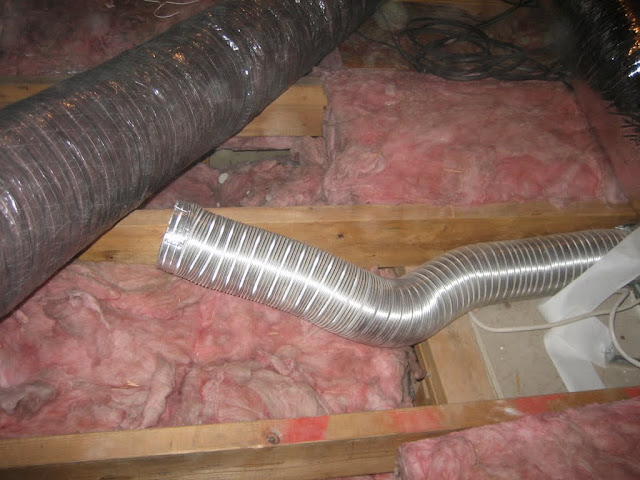
After searching, I found the culprit – the builder had routed the bath fan duct under the fiberglass insulation over towards the soffit (the overhang where the roof meets the house). Often this are has a little bit of ventilation, so many lazy builders run bath fans to this area. However, in this case, there wasn’t even any ventilation slots in the soffit, so the bath fan was just dumping all the moisture straight into the fiberglass insulation.

The homeowners had to spend thousands on mold remediation. They then decided to re-insulate the entire area using spray foam and had to pay to get added attic ventilation to avoid this problem in the future. All because the builder was too cheap and lazy to add a $25 roof vent cap and run the bath fan to it.

Broan roof vent cap

So if you ever consider venting a bath fan into the attic, remember this story. Always vent bath fans straight up and through the roof. Use insulated ductwork from the fan to minimize the chance of condensation in the duct. And use a high quality roof cap, like this one from Broan.

Why not vent out the soffit?

I’ve had some builders argue with me, saying that it’s ok to vent out the soffit. They claim it’s safer because you don’t want to put more holes in the roof because of the risk of leaks.

First off, a high quality, self flashing roof cap like the Broan shown here is very easy to install water-tight. I did two myself and I’m an engineer, not a builder. So scratch that argument – it’s bogus.

Next, think for a moment. What does warm, moist air do? It floats up! Duh. So if you try to vent a bath fan out the soffit, that warm moist air is just going to rise back up through the soffit and back into the attic. It’s hardly better than venting straight into the attic. So under no circumstances should you accept soffit venting of a bath fan. Save $50 on installation today, pay thousands for mold remediation and a new roof tomorrow!

The only acceptable alternative to roof venting is sidewall venting. You might do this when you have a slate roof. In this case, you can route the vent to the nearest exterior sidewall. it’s not perfect, but it will do if it’s not too far away.

Why Attic Insulation is a Big Deal A properly insulated attic is supposed to have about R-

Why Attic Insulation is a Big Deal

A properly insulated attic is supposed to have about R-40 insulation everywhere. This means that the insulation reduces heat loss by a factor of 40 – pretty simple eh? That also means, R-20 roughly equals twice the heat loss as R-40. R-10 is four times the heat loss and so on.

So what’s the R-value of an area of ceiling with no insulation? As it turns out, bare sheetrock on the ceiling has an R-value of about R-1. This means that every square foot of uninsulated ceiling loses about forty times as much energy as a square foot of properly insulated ceiling! 

Put another way, if you have one square foot of uninsulated ceiling, it’s losing as much energy as forty square feet of normally insulated ceiling. So what happens when you have a hundred square feet that are uninsulated, like in this photo? Well, the energy loss from this section of attic are about what the energy loss of a 4,000 SF attic would be!

The take home message is – details matter! Every square inch of your attic should be fully insulated. And if you’re an electrician, take the time to put insulation back carefully after you’re done running wires in the attic. If you don’t you’re basically robbing your customers.

Find insulation problems this winter

The winter snow can be your best friend – at least when it comes to finding where your home is losing energy.

Take a look at this house. Half the roof is covered with snow, while on the other half, the snow is all melted. What’s going on here?

There’s a serious problem with heat leaking out of the living space and into the attic. It takes a lot of energy to melt snow, so undoubtedly, these people are spending lots more on their heating bills than they should.

The first thing to do is to go up to the attic and check the insulation. Is it missing in this area or is there some other reason why the heat is leaking out? Maybe there are heating ducts running through the attic and they’re leaking badly. If your ducts are leaking, you’ll often find that the insulation around the ducts has turned black. Once you learn what to look for, it’s pretty easy to find problems. You might also find mold growing on the underside of the roof.

Another big problem that might be happening is there may be a bathroom vent that is blowing into the attic. You never want this because it can rot out your roof! Usually, you’ll find that the roof sheathing is black or discolored. If you see that in your attic, you know you’ve got a big air leak from the house into the attic.

The main thing is this – if you see something strange like this, you know that there’s a problem. Go find it!