The best way to insulate your attic – part 2

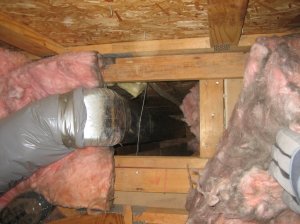
Wow, where's that hole go?

In the first installment on attic insulation, I discussed why it can be dangerous to add insulation to your attic without air sealing the attic floor first. Moisture can slip through tiny cracks in the attic floor and lead to rotten roofs. Given this information, we walked through the process of finding and sealing all those insidious air leaks in your attic, some easy, some difficult. But finally, after fixing all these problems, you could lay more insulation down on your attic floor, more confident that doing so wouldn’t lead to a humid, moldy attic.

But what if there’s an easier way?

Whether you’re building a new house or retrofitting an older one, you can make life much easier on yourself by using professionally applied spray foam insulation that air seals and insulates in one shot. There are two ways of doing this, each with their own benefits and disadvantages. We’re going to review both methods. One is spraying foam on the attic floor, instead of using loose fill or batt insulation. The other is spraying foam under the roof deck. Continue reading

How to prevent your boiler from stealing your money

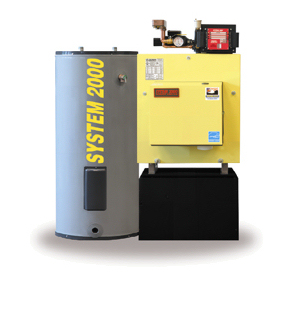
Energy Kinetics System 2000

Energy Kinetics System 2000

In the last article, “Is your boiler stealing your money?“, I discussed why most boilers are ripping you off. Contrary to what almost every HVAC saleperson or tech will tell you, your boiler does not operate at 84% efficiency. It doesn’t operate at 80%! Heck, much of the year, it doesn’t operate at 50% efficiency!

To review, the reasons for this include:

  • High operating temperature
  • Minimal insulation
  • Infrequent use
  • → Outrageously high standby losses

In this article, I’m going to discuss how to do it right. But if you’re too lazy to read the entire article, stop right here and go to the Energy Kinetics website.

But first, I’m going to save you $10,000….

Continue reading

Is your boiler stealing your money?

Boilers - notorious energy hogs

If you have a boiler, chances are, it’s wasting a lot of energy!

At today’s fuel oil costs, (~$3.50/gallon in March 2011), it’s more important than ever to conserve. This is definitely one of those cases where it pays to do your homework.

What if I told you there’s a good chance that your boiler is half as efficient as they told you? You wouldn’t be happy, would you?

Let me tell you a personal story. When I moved in my house, it had a relatively modern boiler, rated at 82% efficiency. It heated the houe and the water. I figured that was pretty good – no need to upgrade, right?

Continue reading

Home Energy Magazine

If you like this blog, then you’ll really like Home Energy Magazine!

Here’s their promo for the latest issue:

If there’s one thing contributing editor Steve Mann learned while attending the 2010 Passive House Conference in Portland, Oregon, it’s that the Passive House approach is anything but passive. In this issue of Home Energy, Steve explains the history of the Passive House standard, where it stands today, and what its future holds. Steve is a HERS rater, Green Point rater, LEED AP, Certified Energy Analyst, serial remodeler, and longtime software engineer.

Read the excerpts below to learn why senior building science consultant John Tooley says we need to Raise the Bar for Home Performance, and how a standard retrofit package can save a homeowner money in The Robo Retrofit House. This issue also features real-life horror stories from the field of energy auditing and a look into how students at Syracuse University experienced a Multifamily Performance Program in on-campus housing.

Click here to access the current issue. If you are a current online subscriber to Home Energy, click here to log in.

Air filters – time for a spring cleaning?

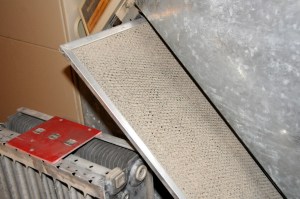
Time to check your air filters! This filter was blue when new.

It’s been a long winter for many of us, and that means the furnace has run a lot! The more it runs, the dirtier your air filter gets.

There’s a ton of information on the web about air filters, MERV ratings, and so on, so I’m not going to repeat that. I’ll give you some links at the end of the article. I’ll discuss the adverse effects that a dirty or improperly installed air filter actually has on your system’s efficiency and potentially, your health.

The old saying that you should check your air filter once a month isn’t accurate. It depends on the type of air filter, how clean you keep your house and how long the system actually runs. The main thing is, if you haven’t checked your air filter in a while, do it now!

A dirty air filter compromises your heating/air conditioning system more than you think. The dirt restricts the air flow through the system. In some cases, this can increase the power draw from the blower. In other cases, it just diminishes the amount of air that comes out your vents. In either case, a dirty air filter equals lower efficiency.

Continue reading

Mini-review: Bosch Ariston 4-Gallon Point-of-use Water Heater

Does it take a long time for hot water to get to your sink? Do you think that it’s wasteful to run the water for a minute or two just to be able to wash your hands? Have you thought about installing a recirculation system for instant hot water? If so, this unit might be for you.

I had all these issues in my kitchen because the kitchen water run is quite a distance from my main water heater. So we just got used to washing our hands in cold water. And if we had to rinse some dishes and some needed hot water, we would turn the hot water on full and wait…and wait…and wait until some hot water came out the faucet. I knew there had to be a better way.

For years I’d researched water recirculation units and found one, the Chillipepper, which people seemed to really like. However, I have granite counters and no convenient place to drill a hole for the power switch. I also have other fixtures on the kitchen water line and I didn’t want my wife to have to remember to push a button and wait for hot water. Finally, because I have long pipe runs from my water heater, this still wouldn’t solve the problem of wasted energy because gallons of hot water would be left in the pipes.

After doing some calculations and determining that any solution using the main water heater would waste several times as much hot water as a point-of-use unit, I broke down and bought one of these mini-water heaters.

Our house has a utility closet in the basement that is directly under the kitchen, so I mounted the unit in there. Plumbing was easy for me, but I’ve done a lot of plumbing work. Most people would need to hire a plumber to install the unit. But because of its size, installation is a snap.

Some people will plumb the cold water intake to the heater from the hot water feed to this part of the house. There’s some logic in this, in that if you need lots of hot water, this heater can provide quick water for hand washing but if you need more water, it flows into the tank and provides you with a much greater supply than this little heater can provide. However this still leads to a lot of wasted energy because you’re leaving all that hot water in the long pipes every time you use a little water to wash your hands.

Instead, I chose to connect it to the cold water supply. My logic was that the kitchen sink really should not be used for long washing sessions. rinse a stubborn dish or wash your hands and that’s it. I also had an ulterior motive – if there was only a few gallons of hot water available, it would force my family to use less hot water. Additionally, our washing machine is on this water circuit, and I prefer washing in cold water but my mother-in-law, who likes to come over and do our laundry (don’t ask!) is old-school, and insists on setting the washer to ‘hot.’ Now she gets the satisfaction of thinking she’s washing in hot, but I know the water heater can only supply a few gallons of hot, so it ends up providing the first few gallons of hot water for the primary rinse, but after that, it can’t keep up with the demand. I consider this a bonus energy saving!

The unit uses normal 110v house current, so you just plug it in a nearby outlet. However, I would recommend a dedicated circuit or one that doesn’t have other heavy loads on it because electric water heaters pull a lot of juice. If the water heater turns on at the same time as you’re toasting some bread, you’ll blow a circuit breaker. So make sure you plug it in an outlet on a circuit that is lightly used.

As far as heaters go, this is an attractive unit. As you can see in the picture, it has a white plastic case. Nothing special, but not just an ugly metal box like most. But really, it goes in a utility closet, so they could have painted it any color they wanted and I wouldn’t have cared!

Does it Work?

The main question is: does it work? The answer is “yes,” up to a point. We can now wash our hands and run the dishwasher (which has it’s own super-water heater built-in). As noted above, it also provides hot water for our front-loader washing machine, but because of its limited capacity (four gallons in this case) it won’t provide a lot of hot water. You can wash for a minute or two before the water runs luke-warm then cold. This can be a plus or a minus depending on your needs. I know some people would find this objectionable. But that’s just the way these things work. They enforce water conservation and force you to change the way you use hot water. If you don’t like this, then a small point-of-use water heater is not for you!

Energy Savings

Like all good geeks, I measured the actual electricity use of the water heater. Because it just plugs in an electrical outlet, I plugged it into my kill-a-watt meter, and make daily measurements to see how much energy it is actually using. I’ve been very pleased with the results so far.

Under normal usage – rinsing a few dishes and regular hand washing in the kitchen sink, it consumes 1.5 to 2.0 kWh of electricity per day. This is about 1/3 the electricity that would be required if I used the main electric water heater and just “lost” the heat in the pipes every time I used the sink. On laundry days, this consumption increase by about 2-3 kWh (about 20 gallons of hot water). So we’d still be better off always washing in cold water, but some habits die hard….

Conservatively, I project that for my family, with it’s modest hot water needs, this unit is saving me about 4 kWh per day (about 25 gallons of hot water). That may not sound like much, but over the course of a year, that’s 9,000 gallons of hot water and about 1,400 kWh of electricity. For most people, that’s a full month of electricity saved every year. In my area, that’s a saving of $232! I’ve checked on Amazon.com, and this water heater cost $169 when I wrote this article, so it pretty much pays for itself in the first year if you install it yourself. If you hire a plumber, it may take a couple years to pay off. And, I haven’t included the ecological and financial cost of the water you’re saving.

Addendum – this is not an “on-demand” water heater

To avoid confusion, I should add that this is not an on-demand water heater. On-demand water heaters use much more powerful heating elements to heat water on-the-fly. They provide an infinite supply of hot water because they heat water as needed. The Ariston water heater is just a miniature storage tank water heater. So it’s the same as a conventional water heater, but tiny.

Support my continued work. Buy it here on Amazon.com

Note on my Amazon store

Like any informed consumer, it probably raises red flags when you see someone reviewing an item then potentially profiting from it. I couldn’t agree with you more. For years, I refused to profit from any of the products I’d recommend to my clients for fear of conflict of interest. But then my wife convinced me otherwise. She said “you’re recommending these products because you buy them and believe in them, not because somebody is paying you to do it. How does it compromise your principles by gathering the products you recommend into one convenient place?” How could I argue with that logic?

So now, whenever I find a cool product, most of which I’ve purchased for my own use, I look it up on Amazon. I check the reviews and make sure that the actual seller seems legit and then add it to my “store.”  I don’t really have a real store. It’s just a convenient way of pulling together the products I’ve found and like.

Bright Ideas for Saving Energy #2 – Check your Ducts

If you have any ducts in your home for heating or air conditioning, you might be losing a huge amount of energy. The good thing is, many of these problems are very easily solved if you’re not afraid to get a little dirty. How does five minutes and a roll of tape sound for a 30% energy efficiency improvement sound?

Attic Mounted Air Handlers

If the main blower (called an ‘air handler’) of your system is mounted in the attic, there’s a really good chance that you’re losing a significant amount of your system’s efficiency due to air leaks.

The air handler distributes air throughout the house. If you look up in the attic, you’ll see a variety of ducts going to and from the air handler. Every connection is suspect, but the worst problems are usually due to leaks where the air handler sucks air in.  This is called the “return” side of the system because the air is returning back to the system from the house.

Why are return air leaks so bad?

Think about the air in an attic. It’s dusty and usually filled with fiberglass particles. It’s also super hot in the summer and cold in the winter. The humidity in the attic usually matches the outdoor humidity, so that it’s very dry in the winter and damp in the summer. Any time there’s a leak on the return side of the system, that nasty attic air is getting sucked in and distributed around the house. Not only is this a serious efficiency problem, it can have health consequences.

How bad are return air leaks?

Consider a typical winter night when the heating system runs. It might be 30 degrees F in your attic. When the system sucks that air in, it has to raise it up to 100+ degrees to heat your home. This is as compared to heating up the 70 degree air in your house. This temperature difference multiplies how hard the system has to work. It is typical for the system to have to use two to four times as much energy to heat the air from the attic as the air from the house. That means a 10% leak gets multiplied to a 20%-40% decrease in your system’s efficiency!

During the summer, the same thing occurs, except now the system is sucking 130+ degree air in and trying to lower it to 50F for air conditioning. Now things get really bad! Your air conditioner cannot reduce the temperature of the air that much, so the system does a much worse job at air conditioning. Plus, it’s pulling all the humidity in, which makes the system work even harder. The net result is that your air conditioner can be almost worthless, or worse than worthless because it will be pulling in so much hot and humid air.

How do I know I have duct leaks?

There are a few telltale signs of return air leaks:

  • Very dusty house – if you clean often and yet you find the house gets dusty fast, you probably have a serious leak.
  • Very dry air in the winter
  • Very humid air in the summer, in spite of air conditioning
  • You feel drafts from the air registers when the system isn’t running
  • Your air filter gets dirty quickly
  • You can see the leaks

Where do I look for leaks?

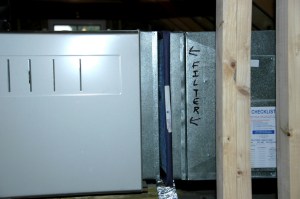
The first thing to do is look at your air handler. The most common problem is when there’s no cover over the filter slot. This problem will easily decrease the efficiency of your system by 30%. In addition, you’ll find that the filter clogs up very quickly, like this one that is completely covered in dirt.

The next place to look is around the ducts near the filter. You can use a smoking incense stick and watch the smoke as you move it around the air handler while the system runs. If there’s a leak, the smoke will suck in, leading you right to the source of the leak! You can also purchase a cheap smoke gun, which works like a fog machine.

Another common place for leaks is where the ducts attach to the ceiling. They’ll usually be connected to the ceiling via a sheet metal box called a “duct boot.” Follow the ducts to each boot. Before you touch anything to look at the boot, take a look at the insulation around it. If it looks dirty or discolored, that’s a sure sign of a leak. It might be a duct leak or a leak from the house into the attic. In either case, you want to find the problem and seal it up.

It’s beyond this post to go into all the details about proper duct retrofits, but at least you can find them and know why you need to fix the leaks. One hint though – never use “duct tape” for sealing ducts. It’s not named right. It will always fail.

How do you know if your air handler is leaking into the attic?

Sometimes it’s really obvious. Sights like this may me cringe.

Leaks from the air handler into the attic can be pretty obvious during the winter. If you see a lot of snow melting off your roof, usually there’s a duct leak below it in the attic. So the first thing you should do is look at the outside of your house if there’s snow on the roof. There’s another post all about this that will help you find those problems.

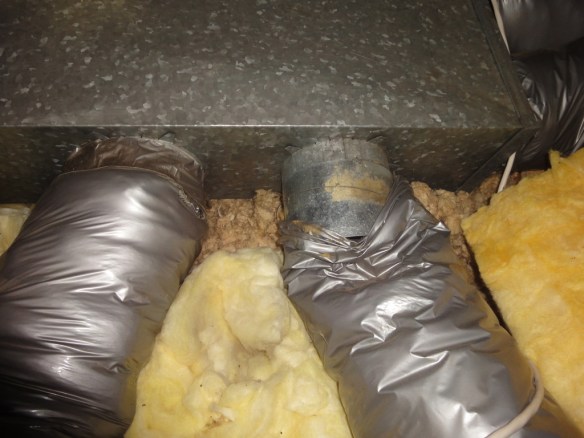
The easiest thing to do is check where all the ducts connect to the air handler and the main trunk line (the big duct that comes off of the air handler, to which all the other ducts are attached). Make sure that all the ducts are tightly attached and air-tight. Each duct that is lose could be responsible for a 5%-10% decrease in your system efficiency.

This should be enough to get you started. For minimal investment in time and supplies, you can often improve your system’s energy efficiency by more than you could by purchasing a new, high-efficiency system. Even if you did buy a new system, if you don’t fix these problems, it will still work more poorly than an average system with excellent ducts.

The general rule is – if it looks wrong, it probably is!

-Happy hunting

Energy Costs

Sorry, I couldn’t come up with a snappy title for this one. This is about money and energy, so it’s a bit dry.

After my recent post on water heating, a friend dropped me a note and reminded me that the economics vary considerably depending upon the cost of the fuel. This is absolutely true, though unless you’ve studied a lot of utility bills, you might not realize just how much energy costs can vary.

Generally speaking, we have four energy sources that are widely available:

  • Natural gas
  • Propane
  • Heating oil
  • Electricity

Depending on where you live, the cost of each can vary widely. To complicate matters further, the price varies throughout the year, usually in proportion to the demand. So, for example, heating oil cost is the greatest in the dead of winter when you need it the most.

For the rest of this post, unless I note otherwise, I’ll be comparing fuels based upon their normalized cost. That is, I’ll be comparing the cost based upon the same amount of useful energy contained in the fuel. This can get confusing because most people refer to cost per gallon, but that’s meaningless because a gallon of liquid propane contains far less energy than a gallon of heating oil and you can’t even buy a gallon of natural gas or electricity.

Instead, we’ll be comparing fuels based upon their cost per million BTUs (also called MMBtu). What’s a million BTUs? It’s:

  • 7.25 gallons of heating oil
  • 10 CCF (or therms) of natural gas
  • 10.92 gallons of liquid propane
  • 292.91 kilowatt-hours of electricity

You can think of it as about the energy contained in half a tank of gas.

So the million dollar question is, how do fuels compare based on an equivalent amount of energy that they’re capable of producing?

To answer this, we have to look at a range of prices. For example, on the West coast and in the Northeast, fuel costs are quite high. Electricity in most areas is $0.15-$0.20 per kilowatt hour (KWh). That means the cost per MMBtu of electricity ranges from $43.94 to $58.58. But in some areas, or under certain rate plans, electricity is as low as $0.07 per KWh so the cost per MMBtu drops to $20.50.

So you see, this really complicates cost comparisons. That’s a three times range of cost. And it only gets more complicated when you compare multiple fuels! To simplify matters, here’s a table with each fuel, a range of costs, and then the corresponding range of costs per million BTUs.

Now the picture is getting a little clearer. You have natural gas at a low cost of $7 per MMBtu up to Electricity at almost $59 per MMBtu. That’s quite a range for the same amount of energy!

Let’s make this even more interesting! Instead of an abstract term like MMBtu, let’s convert this to “1,000 gallons of hot water”. I have to make a few assumptions here because this new calculation depends upon the starting and ending temperature of the water. For this, I’m basing the calculations on 50 degree water coming in and 130 degree hot water.

Heating 1,000 gallons of water takes 666,400 BTUs of energy. So if you were able to capture 100% of the energy contained in each of the fuels above and transfer it to the water for heating, you’d get the following:

What does the fuel really cost?

Notice that in all this discussion, I’ve kept things simple by just talking about the energy contained in the fuel. That assumes 100% efficiency. Unfortunately, nothing happens with 100% efficiency so we now have to complicate matters further by considering the actual efficiency of each system.

For these calculations, I’m going to use the typical efficiencies achieved in most households. You have to build your own spreadsheet if you want it to be accurate for your own situation.

Water heaters and their corresponding efficiencies

Water heaters are rated by their “energy factor.” This is a rating based upon the combustion efficiency and the heat loss of the storage tank, all measured under “typical conditions” whatever that means. The energy factor is a number from 0.0 to 1.0 representing 0% efficient to 100% efficient. I don’t know why they didn’t just use % efficiency, but they didn’t, so just remember an EF of 1.0 is perfect.

Natural gas, propane or standalone oil water heaters have an EF of about 0.59. Yes, you read that right – your conventional, combustion type water heater is only 59% efficient, if you’re lucky.

An electric storage tank water heater has an EF of about 0.90, or 90% efficient.

There are other technologies and types of water heaters, but in practice, these numbers apply to the vast majority of the homes in the U.S.

This tells us that the actual cost to heat your water is considerably different than what I showed in the tables above because the efficiency changes things, making electric water heaters much more appealing if you have cheap electricity.

Just for completeness, I’ll convert the table above to include these efficiencies. So the following table represents the cost to heat 1,000 gallons of water in a real water heater.

This final table represents the price range that a consumer would expect to pay to heat 1,000 gallons of water based upon typical water heater efficiencies and the range of fuel costs across the United States.

It has been a long journey, but if you followed it, you should now be able to figure out how much it’s really costing you to take a 20 minute shower or wash clothes with that old washer.

Postscript

In another post, I’m going to describe how you can analyze your own utility bills to see how much fuel you’re actually using for hot water. All these numbers are great, but what’s really important is how much it’s costing you to heat your water based upon your actual consumption.

Question: What are your thoughts on solar heated water?

Question: What are your thoughts on solar heated water?
Answer:

Solar water heaters are one of the most underutilized alternative energy systems in the U.S. What could be better than reducing your energy consumption using the sun? Many other countries have “got it” and you’ll see solar water heating systems on most roofs.

There are three problems with them – we charge too much ($7000-$10,000), there aren’t enough qualified installers and they require maintenance. But if sized and installed properly, most families could satisfy 75%-90% of their hot water needs using solar on any sunny day.

Here are some resources for further reading:

Build it Solar – Site for solar DIY’ers.

U.S. Dept. of Energy

Wikipedia – Extensive article on solar water heating


Water heaters – efficiency, insulation, costs…oh my!

After my last try at this long post, I’m going to break this one down into a few parts. There’s lots of material here, so bear with me.

So recently a friend asked me about water heaters – how much energy do they use and is adding insulation a good idea. Let’s start with energy use…

Energy Consumption

Just how much energy does a water heater use? Is it as significant as people say?

In a word – “YES!” – water heaters are a major consumer of household energy.

No matter how you slice it, this is a numbers question, and I’m a numbers guy. So get out your spreadsheet and prepare to think about BTUs and Energy Factors!

Let’s pull out a famous pie chart showing a comparison of average energy use for different things around the house. I grabbed this from the Energy Star website because they should know, right?

Well, as it turns out, I don’t know what fantasy world they’re getting their numbers from, but by my numbers, water heaters are responsible for 20%-50% of your utility bills, and I’ll show you how.

Here’s the problem – the answer to this question depends upon whether you’re a single person, living alone, who only showers once a week in tepid water, or if your household is multi-generational, with grandparents, parents, and seven children making loads of laundry every day. The occupants are the biggest factor in hot water use, so let’s look at them and how they affect the equation.

Hot water use based on occupancy

On average, people use 25-50 gallons of hot water per day, per person, so right there, you have a wide range. Think about it for a moment…If you shower every day for 10 minutes, that’s 22 gallons of warm water per day. Wash your hands a couple times and you’re using another gallon or two. A load of laundry? 10-30 gallons, and so on.

I emphasized “warm” water because most of the calculations I see count every use of water as all-out hot water, which is stupid. Nobody just runs the water on full hot unless they have their water heater set to a very low temperature. So when you take a shower, you might use 2/3 hot, 1/3 cold water. A 10 minute shower with a 2.5 gallon per minute shower head is 25 gallons of water but about 17 gallons of hot water.

However, there are other complications. For example, every time you run the hot water, you’re filling up the pipes between your water heater and your spigot with hot water. When you turn it off, all the heat in that water is lost. So you might run the faucet for 30 seconds to get warm water in the first place, then use it for 30 seconds and turn it off. The heat in the water in the pipes is “lost”. Yes – lost.

Some would argue that the heat goes into heating your home. Yes, true enough, you capture that waste heat during the winter. But during the summer? Oh…now that waste heat, usually 130 degree hot water, means your air conditioner has to work harder. It’s not so simple, is it? So for my calculations, I say that’s lost energy.

These are all reasons why the spread of usage is so wide. But let’s be conservative and use 25 gallons of hot water per person per day. How much energy is that?

Not so fast. How many people are in your household? Is it just you or do you have a family? For this example, I’m going to talk about a typical family of four. You can just multiply or divide the numbers based upon your own household size.

As it turns out, if you run the numbers, and I have, you’ll find that using 100 gallons of hot water per day costs you between $50 and $100 per month depending on your fuel costs and a few other factors like the efficiency and temperature of your water heater. Without turning this into a thesis, let’s just say it costs $70/month for hot water.

Depending upon the season and energy costs, the total monthly utility costs for a family of four will be $200-$400. Much more if it’s the dead of winter with an old oil boiler, less if you have a state-of-the-art geothermal heat pump. But this gives you an idea. So, if you’re on the low end of this, then the water heater accounts for 35% of the utility costs. On the other hand, it might be 10%-15% during the winter. But that gives you an idea of the typical ranges.

What does this all mean?

When you cut through all the verbiage, you discover that hot water is a big deal. Typically it’s 20%-30% of your total utility costs when taken over a full year – maybe around $750. This means that you should look at water heating as a “high leverage” area for improving your home’s energy efficiency.

I’ll touch on how to reduce your water heating bills in the next installment.