In the first two posts of this overly wordy series, we saw a few ways to insulate an attic while avoiding some of the worst problems that can lead to moldy, rotten attics and roofs.
If you recall, the big problem is that moisture from the house rises up through the walls and all the little cracks around light fixtures, hatches, wiring, and the moisture condenses on cool surfaces. Over time, this will lead to mold growth and potentially, rotten roofs.
How do you know if you’ve got a problem? I’ll give you a hint – if you have ice forming under your roof like in this picture, you had better do something before you have to replace your roof!
In the first installment on attic insulation, I discussed why it can be dangerous to add insulation to your attic without air sealing the attic floor first. Moisture can slip through tiny cracks in the attic floor and lead to rotten roofs. Given this information, we walked through the process of finding and sealing all those insidious air leaks in your attic, some easy, some difficult. But finally, after fixing all these problems, you could lay more insulation down on your attic floor, more confident that doing so wouldn’t lead to a humid, moldy attic.
But what if there’s an easier way?
Whether you’re building a new house or retrofitting an older one, you can make life much easier on yourself by using professionally applied spray foam insulation that air seals and insulates in one shot. There are two ways of doing this, each with their own benefits and disadvantages. We’re going to review both methods. One is spraying foam on the attic floor, instead of using loose fill or batt insulation. The other is spraying foam under the roof deck. Continue reading →
Many of my posts come back to air sealing and insulating the attic. Why is that?
If you’ve done any searching about home weatherization, insulation, energy efficiency or related topics, you’ve probably come across the picture shown above. And for good reason – it clearly shows all the common sources of air leaking into (infiltration) and out of (exfiltration) your home.
One subtle part of the picture is that the size of the arrows represents the relative amounts of air leakage from each location. See all those big orange arrows going up into the attic? Those tell you that large amounts of warm air from your house leak into the attic during the winter. This is why all us energy geeks keep spouting about the importance of sealing up the attic before you waste you time on things like replacement windows, sealing electrical outlets, and so on. You can spend thousands of dollars and countless weekends working on all these other areas and it probably won’t improve your home’s energy efficiency as much as just focusing on your attic.
Insulation filters the air leaks from your house, showing you signs of energy loss
You might have noticed some black insulation in your attic or maybe around the perimeter of your basement, where the house rests on the foundation. What does this mean? Is it moldy? Wet? Why is the insulation black?
In fact, black insulation is the energy auditor’s best friend because it tells us where the problems are. In just a few minutes of looking around the attic, you can find the most serious air leaks from the house. Here’s why…
Disclaimer: while I think all the information presented here is accurate and scientifically valid, you are advised to consult a *professional before changing your home. This article covers just one component of your home. Your specific home may have conditions that override the comments contained herein.
*By professional, I mean an experienced building scientist, not your local carpenter or roofer or even a structural engineer or architect. While many of these people are artists in what they do, most have no training in building science or engineering and cannot be trusted to properly design a roof assembly. Likewise, you wouldn’t hire a building scientist to swing a hammer and build your roof! Cathedral ceilings are very popular – they give rooms a feeling of openness and an added aesthetic dimension. At the same time, they are responsible for a variety of building problems and homeowner heartbreak. What causes these problems and how do you avoid them?
There are a variety of climate zones. The south-eastern United States is hot and humid, while the north east is cold. The mid-Atlantic states, where I live, is mixed – during the summer it is hot and humid, during the winter it is cold. The south west is mostly hot and dry and the northwest is moderate in temperature but very humid! Each of these climate zones has its own particular building details. However, all must follow the laws of physics.
Physics tells us that moisture moves from areas of high humidity to areas of low humidity. If it’s more humid outside, moisture wants to come in. And when it’s more humid inside, the moisture will move toward the outside. Simple!
Here’s a handy, albeit highly incomplete, video on insulating your crawlspace:
Insulation installed upside-down
The positives:
They installed it with the vapor barrier put firmly up against the floor of the room above – this is actually correct. Most people install it upside-down and staple the paper vapor to the floor joists – this is totally incorrect. When you do that, you end up with moldy insulation like shown here.
They stressed the importance of air sealing and even showed the band joists (technically called the “rim joist”). Kudos for that!
The not-so-good:
They noted the importance of installing a vapor barrier on the floor, though they should have mentioned that you typically only do that for a dirt floor. They should also have mentioned that just laying plastic on the floor won’t do much to stop moisture from coming up. Any place air can flow, water vapor will go!
The next (commercial) video presents the situation in crawlspaces accurately and proposes a solution that appears to be done thoroughly and professionally. Note that I have no personal experience with the company that produced the video. Regardless, it is well worth a view.
Signs of moisture and air flow in fiberglass insulation
When you climb into an attic and see this, you know something is seriously wrong. In fact, if your home isn’t very old, your insulation should be clean like when it was installed. The reason you get black insulation like this is because air and moisture are moving through the insulation, and it’s acting like an air filter.
The reason I’m showing you this picture is because it’s an example of the wrong insulation being used for a job. I feel pretty strongly about this because I’ve seen numerous homes where fiberglass has been installed in open walls like this and in almost every case, the insulation was seriously compromised – it was buckling under its own weight or simply falling out of the wall cavity. Or, in cases like this, it was hiding a big hole in the wall that should have been air sealed.
Let’s walk through the different insulation types and compare their main attributes: R-value, ability to reduce air movement, suitability for retrofit applications, and other characteristics.
This video is a promo for my upcoming video series, Building Science vs. B.S.
You hear B.S. every day….
***B.S.***
houses need to breathe too much insulation causes roofs to rot furnaces dry out your house cold water boils faster than warm water green building is always more expensive ridge vents always help cool your roof and reduce moisture
***B.S.***
Unfortunately, B.S. like this gets spread by supposed experts, further perpetuating these damaging myths.
The problem is, people are really bad at reaching proper scientific conclusions. Our brains are wired to look for patterns, and research has shown that we create patterns where none really exist. For example….
Did you ever buy a new car, then suddenly notice that model everywhere?
If you’re a woman who has been pregnant, didn’t it seem like there were lots more pregnant women around?
It’s called “perceptual vigilance” and it leads to all sorts of incorrect conclusions. It causes people to think something in their environment has changed, while in fact, it is only their brain that changed!
There’s another favorite term among scientists: “correlation is not causation.” This is a related cousin to perceptual vigilance. What they’re saying is that just because two events appear to be correlated, it doesn’t mean that one caused another.
Insulation does not cause roofs to rot!
Let’s start with a simple piece of B.S., usually spread by poorly informed contractors.
My good friend Jerry takes to the keyboard today, telling us the trials and tribulations of having a house adjacent to a hill….
__________________________
We bought the house not knowing the backyard had really bad water retention issues (note: never buy a house when there’s snow covering the yard). After heavy rain in the spring, the back yard would essentially be an unmowable mudpit for several weeks. We had French drains installed which greatly alleviated the issue. With the remodel, we figured we’d further address the wet yard by channeling the downspouts from the gutters in the back of the house into an underground collection pit (a dry well), which would run off into a rocky bed leading to the street. This also worked well.
Unfortunately, during construction they built an open crawlspace under what would later become the kitchen extension. Open to the sun and the stars…and the rain. The first rain after they built it happened on a weekend. The carpenter/job manager came over without us even calling, luckily, and build a makeshift cover out of plywood. But it was a heavy rain and we had to run and get a pump as well to keep the crawlspace from filling up and coming into the basement. Eventually they built the kitchen over it, and that was the end of that. Or so we thought.
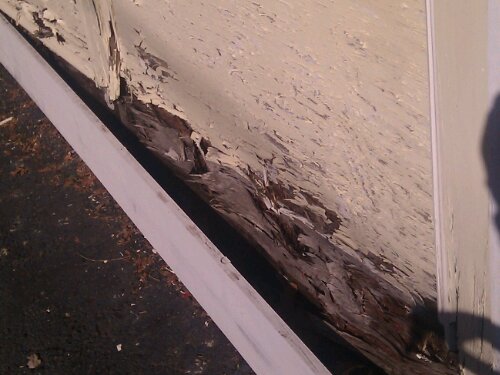
I regularly come across scenes of rot. So many that I am going to start a page of rotten pictures.
If you have some of your own, please send them with a description and I’ll share them with our readers.
Head on over to this page for more and to submit your rotten stories!




 Ted's Energy Tips