Unknown's avatar

About T.D. Inoue

Ex-digital imaging entrepreneur, Green building advisor, professional problem solver. Amateur chef. Avid ice cream maker and general troublemaker

Q&A – Should I get a high efficiency heat pump?

A friend dropped me this email yesterday, asking for some advice (slightly edited):

We spent a lot on oil last winter.  We have a 23 year old heat pump which gives us A/C in the summer, but no heat any longer.  I had a proposal from the installer for a new 14.5 seer heat pump replacement.
Here is the question: how much more efficient will that unit be compared to our old unit?  We are not convinced that it is worth the cost, so we thought you might give us a ball park estimate of potential savings.  Bottom line is enough: does this sound like a good decision?

This is such a great question, that I wanted to share it, and my answer, with the rest of you.

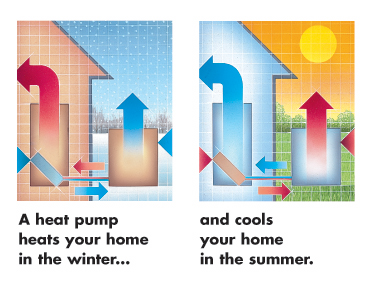
Let’s start with the basics – what is a heat pump?

Continue reading

LED Bulb under $10 at Lowes!

A friend just turned me on to this special deal at Lowes in Pennsylvania. The bulb, which he noted is manufactured by Feit (a highly reputable brand) is currently available for $9.98 at this link.

I just bought five more of the $20 Feit bulbs, so I was a bit chagrined to learn about this. But I’m happy for the rest of you. At under $10, there’s really little reason not to try a few of these around your home.

Keep in mind, this is a 40 Watt equivalent, so it’s not the brightest bulb around. However, it’s directional, so it’s good for those areas where you have downlights or other areas where the light output pattern doesn’t have to be totally uniform.

If you get one, please post your comments here. I’ll pick one up myself when I get a chance, but I’d love to hear your feedback.

update: I just looked at the ad more closely – it’s 50% off until 5/9/2011 so buy now!

How to Increase the Energy Efficiency of Your Existing Home

This post by an energy auditor in central PA summarizes a lot of the information required to make your home more energy efficient, all in one spot. It’s like you took all my posts to date and wrapped it up into a single article! Definitely worth a skim.

For those of your unfamiliar with ChrisMartenson.com, Chris is a scientist who, several years ago, started investigating peak-oil – the fact that at some point, you can’t extract oil from the Earth any faster, and from there, it’s downhill. As he investigated it, he got more and more worried, because pretty much everything we do depends upon having essentially an unlimited supply of oil.

Chris is passionate about this cause. So passionate that he produced a series of videos and is traveling the world giving lectures about how to prepare. At first it seems nutty, especially if you’re of the mindset that “technology will always find a solution”, but if you listen carefully and do your own research, you may find yourself buying in to what he says.

I started following him a few years ago, and combined what he said with what I learned from various investment newsletters and other sources. That gave me an advanced warning to shift from classical stocks into metals and mining a few years ago, before the market tanked and mining stocks skyrocketed.

Whether you agree with him or not, his “Crash Course” is well worth viewing as it provides additional insights that you can use to better understand the complex, resource limited world in which we’re now living.

Tip of the day: pre-rinse in cold water

In this day and age, most of us have dishwashers, and yet there’s still quite a bit of controversy over how to wash dishes. Some wash every dish by hand. Some just throw them in the washer. Others wash the dishes by hand then put them in the dishwasher to make sure they get really clean?

This is an energy efficiency blog, so I’m going to look at this from an energy standpoint. If you live in New Mexico or elsewhere where water is in extremely short supply, you’ll probably have methods that are more water efficient.

You might have noticed that things just aren’t washing as well as they used to. You’re not imagining things! In fact, new soaps are “phosphate free” and people all over are complaining that dishes no longer come out clean. I certainly have. Here’s one article about the topic.

Because of this, more people than ever are hand-washing dishes. Either as a pre-rinse or giving up on dishwashers. So energy efficient rinsing is becoming even more relevant.

Continue reading

The Sustainable Building Advisor Institute

It’s been a busy week for me with my startup, OurKudos.com, so I haven’t had much time to contribute to Ted’s Tips. But now on a rainy Friday night, I feel the need to decompress and talk about energy efficiency and sustainable building again!

I got an announcement today from the Sustainable Building Advisor Program, an organization dear to my heart. They have changed their name to the Sustainable Building Advisor Institute and launched a new website.

Why is this so exciting? The SBA program is a wonderful organization dedicated to training people in the world of sustainable building. Unlike so many organizations that have sprung up in the last few years simply to make a buck on the “green” excitement, the SBAi is truly about the teaching. It’s a very small organization of dedicated individuals, passionate about what they do.  Continue reading

Ultimate attic insulation

Icy roof deck, not a good sign!

In the first two posts of this overly wordy series, we saw a few ways to insulate an attic while avoiding some of the worst problems that can lead to moldy, rotten attics and roofs.

If you recall, the big problem is that moisture from the house rises up through the walls and all the little cracks around light fixtures, hatches, wiring, and the moisture condenses on cool surfaces. Over time, this will lead to mold growth and potentially, rotten roofs.

How do you know if you’ve got a problem? I’ll give you a hint – if you have ice forming under your roof like in this picture, you had better do something before you have to replace your roof!

Continue reading

Building Science vs. B.S.: Radiant barriers – the perfect insulation?

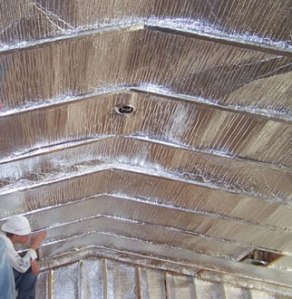
An attic radiant barrier application

Before I dive into another couple thousand words on attic insulation, I thought we’d take a break and talk about an energy saving miracle product!

What if there was an insulation product that was light, cheap, easy to install, and gave an incredible R-value?

If you believe the advertising, then radiant-barrier bubble wrap insulation is this ‘miracle’ insulation. In that advert, they claim an R-value of 15.67 for a quarter inch thick piece of aluminum coated bubble wrap! Wow, that’s over R-60 per inch! All our insulation problems are solved!

Continue reading

The best way to insulate your attic – part 2

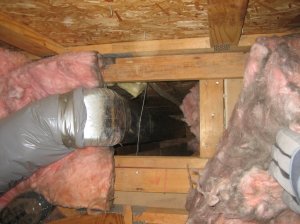
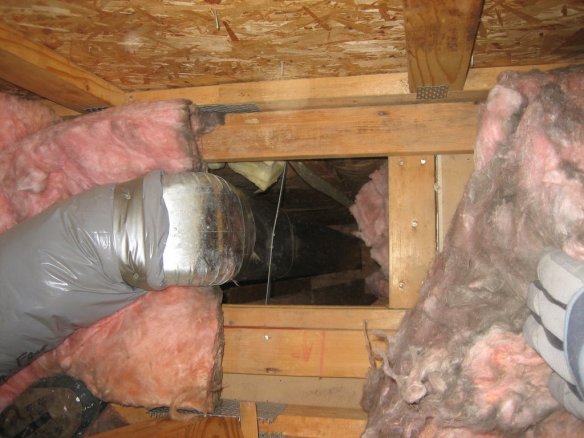
Wow, where's that hole go?

In the first installment on attic insulation, I discussed why it can be dangerous to add insulation to your attic without air sealing the attic floor first. Moisture can slip through tiny cracks in the attic floor and lead to rotten roofs. Given this information, we walked through the process of finding and sealing all those insidious air leaks in your attic, some easy, some difficult. But finally, after fixing all these problems, you could lay more insulation down on your attic floor, more confident that doing so wouldn’t lead to a humid, moldy attic.

But what if there’s an easier way?

Whether you’re building a new house or retrofitting an older one, you can make life much easier on yourself by using professionally applied spray foam insulation that air seals and insulates in one shot. There are two ways of doing this, each with their own benefits and disadvantages. We’re going to review both methods. One is spraying foam on the attic floor, instead of using loose fill or batt insulation. The other is spraying foam under the roof deck. Continue reading

What’s the best way to insulate your attic? or How I learned to think like a child

U.S. EPA Air infiltration poster

Many of my posts come back to air sealing and insulating the attic. Why is that?

If you’ve done any searching about home weatherization, insulation, energy efficiency or related topics, you’ve probably come across the picture shown above. And for good reason – it clearly shows all the common sources of air leaking into (infiltration) and out of (exfiltration) your home.

One subtle part of the picture is that the size of the arrows represents the relative amounts of air leakage from each location. See all those big orange arrows going up into the attic? Those tell you that large amounts of warm air from your house leak into the attic during the winter. This is why all us energy geeks keep spouting about the importance of sealing up the attic before you waste you time on things like replacement windows, sealing electrical outlets, and so on. You can spend thousands of dollars and countless weekends working on all these other areas and it probably won’t improve your home’s energy efficiency as much as just focusing on your attic.

Continue reading

What does it mean if your fiberglass insulation is black?

Insulation filters the air leaks from your house, showing you signs of energy loss

You might have noticed some black insulation in your attic or maybe around the perimeter of your basement, where the house rests on the foundation. What does this mean? Is it moldy? Wet? Why is the insulation black?

In fact, black insulation is the energy auditor’s best friend because it tells us where the problems are. In just a few minutes of looking around the attic, you can find the most serious air leaks from the house. Here’s why…

Continue reading