Five things to do to prepare for a hurricane

Hurricane Irene - 8-27-2011

So you’re glued to the TV, watching as the “storm of the century” approaches. What to do?

I’m a big believer in knowledge and education but honestly, I try to tune out big media coverage of the storm. Why? Because they do everything they can to hype the storm. The bigger and scarier they make it seem, the more viewers they attract.

I’m going  to take a little different approach than most of these lists. There are hundreds of “hurricane check lists” telling you to fill your bathtub with water and stock up on batteries and food. No, I’m going to give you the practical homeowner tips that nobody else tells you.

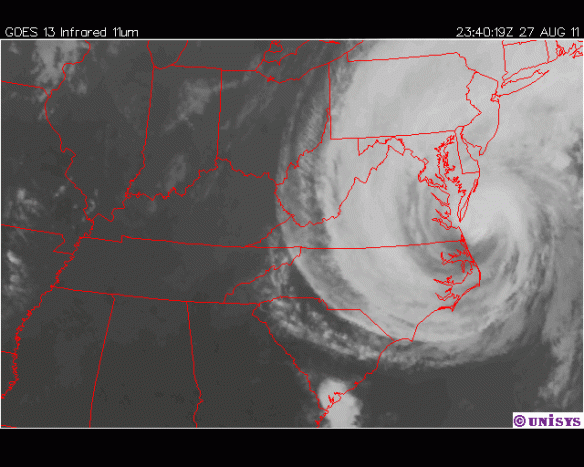
Tip #1: Monitor the pure satellite images

My favorite site for no-nonsense satellite images is Unisys weather. Yes, the old-time computer company has the basics. The most informative images are the standard IR (infrared) or the WV (water vapor) image. These images give a great overview of what’s happening on a large scale.

Tip #2: Keep an eye on rivers and streams

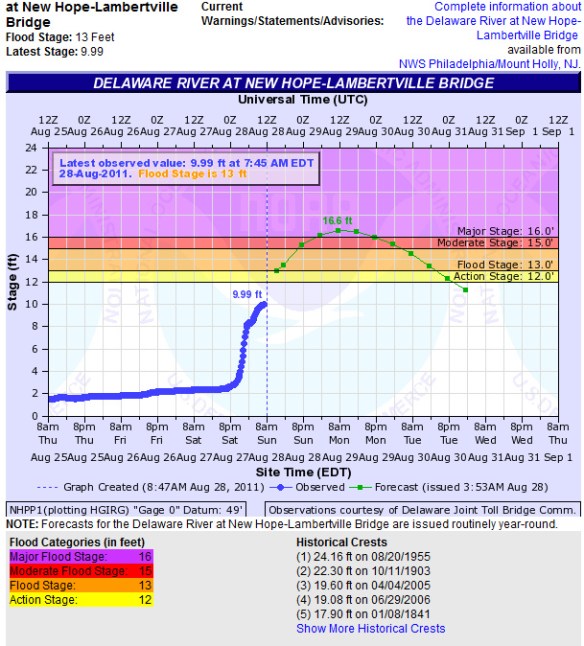
The National Weather Service has a great website that few people know about. It has detailed information about projected water levels based on gauges and computations. Here’s a link for the Delaware River gauges in my area. Here’s the national map so you can choose the information for your area.

River levels with projections after Hurricane Irene

Continue reading

Ted’s Top Tips to Help You Beat the Heat!

Record temperatures are creating uncomfortable conditions all over. Here in Pennsylvania, we’re expecting near 100F temperatures for much of this week, while Chicago just suffered through a heat index of 115F!

Along with high temperatures come big utility bills because of all the air conditioner usage. In this post, I’ll give you some tips for how you can “beat the heat” without breaking the bank!

Why Things Get Hot

If you’ve read any of my posts, you know that I like explaining things because I want you to understand WHY things occur. Once you know why, you can figure out solutions yourself.

Why do we use umbrellas to block the Sun? We all know that it’s cooler in the shade because the sun radiates heat. So if you can block the solar radiation, you can block a lot of the heat that it brings.

Even if you’re in the shade, it can get darned hot! If you’re sitting in your house, you’re being shaded by the roof – no direct sun is hitting you yet you’re still hot. Why? Because there’s still a lot of heat coming in – from the hot roof, the walls, sun shining through the windows and hot air entering the house.

There are other things that heat your house in the summer. Some obvious, some unexpected. You probably know that conventional light bulbs put out a lot of heat. In fact, each light bulb acts like a little space heater. But did you know that every appliance in your home, from your television to your refrigerator, is also pumping heat into the house 24-hours a day? And your water heater, especially if you have an oil boiler for your hot water – those throw off a ton of heat!

Quick recap -houses get hot in the summer because:

  • Solar radiation heats objects in direct sunlight, like your roof
  • Hot air carries heat directly into your house
  • Hot air and solar radiation heat your walls
  • Solar radiation enters through windows and skylights
  • Appliances and lights produce waste heat that enters your home

Beat the Heat!

Now that you know what causes your house to get hot, let’s see what you can do about it. I’ll start with the easy ones and work up to ideas that require more changes or greater investments.

  1. Wear light clothes. Ok, this one is so obvious that I’m embarrassed to write it! But simple things like shorts, a lightweight shirt and no socks make a big difference to your comfort level.
  2. Drink ice water or other no-calorie drinks. Cold drinks help reduce your body core temperature, that’s good. But don’t drink beer or soda or eat ice-cream and expect to stay cold. Anything with calories adds energy to your body, and that energy makes you less comfortable in hot weather.
  3. Use fans to circulate air around you, but only when you’re in the room. Fans cool you by speeding the evaporation of sweat and by carrying heat away from your body. But when you leave the room, turn off the fans or you’ll be wasting electricity AND adding heat to the air because the fan motor gets hot. Remember – fans do not cool the air!
  4. Turn up the temperature on your air conditioner. A slight increase in the temperature setting of your AC results in a significant reduction in the amount it runs. For example, raising the setting from 72 to 76 can reduce the energy use by 25%. Use a fan and turn up the temperature and you’ll see the savings on your next utility bill.
  5. Raise the temperature on your AC when you’re not at home. There’s a lot of debate on this one, but let me put it to rest – you save considerable energy by turning up your AC when you’re not at home. Yes, you have to crank the AC when you get home, but there is definitely a savings – you will save much more energy doing this than leaving the AC at a constant temperature all the time.
  6. Open the windows at night only if it’s cool and dry. Natural cooling at night is a great way to cool the house only when the air is dry. A big use of air conditioning is to remove moisture from the air so if you open your windows at night or in the morning when it’s really humid out, you’re filling your home with water. After that, your air conditioner has to work overtime to remove that moisture. So resist the temptation to open up the house when the humidity is high.
  7. Turn off lights when you’re not in the room. This is always good advice, but it makes even more sense when it’s hot out. Remember, those lights are little space heaters. The longer they burn, the more your air conditioner has to run to remove the heat that the lights put out.
  8. Replace lights with high-efficiency bulbs. This requires a little investment but it pays off year round. Compact fluorescent and LED bulbs are much more efficient than conventional bulbs mostly because they convert more of the electricity into light. I’ve written more than enough about the direct energy savings from these bulbs. Stop making excuses and replace those bulbs!
  9. Install a new fridge. And recycle your old refrigerator. The old energy hogs throw off an amazing amount of heat. A new, super-efficient fridge can pay for itself in a few years and it will heat your house less.
  10. Add insulation to your attic. If you don’t have at least a foot of insulation in your attic, you’re probably under-insulated. If you have a house from before the 1980’s, chances are, you only have a few inches of insulation. Going from 3 inches to the recommended 14″ of insulation (maybe R-9 to R-42) will reduce the amount of heat moving from your attic into your home by about 80%. A good insulation job is something you’ll appreciate year round.
  11. Shade your windows. Remember, a big reason things get hot is because of sunlight. Ideally, you don’t want direct sunlight entering the windows. The best way is by using trees or bushes to shade the windows. If that’s not possible, exterior awnings do a great job, though many people object to the aesthetics. If that’s you, then get interior cellular shades to block the direct light.
  12. Get windows with heat reflective coatings.  In recent years, window coatings have gotten truly amazing. A good window can block 90% of the heat from entering from the sunlight. This also protects your carpets from damaging UV radiation. An added benefit is that these same windows will hold in more heat during the winter and they’ll be less drafty. So replacing old, leaky, single-glazed windows with tight, low-e, double or triple-glazed windows can make a big difference in your comfort year round.
  13. Install a white-roof. Depending on your climate and your current insulation, this may or may not make sense. If you have lots of insulation, than the amount of heat coming in from your roof can make very little difference. But if you’re changing your roof anyway, get a reflective roof. This can substantially reduce attic temperatures and therefore the heat entering your home.
  14. Install a more efficient air conditioner. New air conditioning is usually my last recommendation. You’ll spend thousands of dollars and depending on where you live, you’ll may only use it a few months per year. However, if you have an old unit, it’s probably operating at less than SEER 10, so switching to a new SEER 18 unit can cut your AC bills nearly in half.

Swimming Pools: Save Energy While Enjoying the Summer Heat

Is there an Energy Hog in your pool?


If you have a swimming pool, you probably hate to see your utility bills during the summer. Chances are, you’ve attributed the high bills to your air conditioner. But pools and their associated pumping equipment might be responsible for at least as much energy use as that big central air conditioner!

Why does the pool use so much electricity and is there anything you can do about it?

Pumping water takes a lot of energy. Just think about the last time you took a swim. It takes all your energy to swim the length of the pool, while you could walk this distance without difficulty. In the same way, moving water, because of its weight and resistance to flow, requires a lot of energy.

So if moving water naturally takes energy, how can you reduce the consumption?

Without getting too technical, moving a gallon of water through pipes takes much less energy if it is moved slowly than quickly because of water turbulence. Just knowing this allows you to dramatically reduce your pool pump’s energy use.

Unfortunately, most pools are designed with vastly oversized pool pumps. For example, my pool had a 1.5 horsepower (HP) pump. This is useful for backwashing the filter, but for general filtering, using such a huge pump results in less efficient filtering and much more energy consumption. Worse, that 1.5 HP pump might pump less than twice as much water as a .5 HP pump due to the high turbulence caused by the larger pump.

You’ll find that running that 1.5 HP pump for 10 hours a day (fairly common for pool pumps) will add about 15 kilo-Watt-hours to your electric usage. For many households, that’s an increase of 30%-50% of the home’s total daily electric consumption! Over the course of a summer, that adds up to hundreds of dollars in increased electric bills.

For my pool, I installed a two speed pool pump that allows me to run at 3/8 HP for general filtering. The water flow is ample for filtering yet it uses about 1/8th the electricity as when it runs at 1.5 HP. The only time I turn it on ‘high’ is when I’m backwashing the filter. Other than that, it runs 12 hours per day at a few hundred Watts (a total of about 3.6 kWh/day). When I convert kWh/day savings (over 10 per day) to dollars, I’m saving more than $1.60/day which is about $150 per summer in saved electric bills.

If you’re building a new pool or replacing an old pump, installing a multi-speed or variable speed pump is a no brainer. At a cost of about $500 for a high end two-speed pump or $1000 for a variable speed, the savings will pay for the pump in a 3-6 years. About half that if you’re replacing an existing pump and would have to buy a new pump anyway. Pu another way, that’s like having an investment that pays 15%-30% dividends – in these economic times, you’re not going to find a better investment!

Your specific numbers will vary depending upon your electric rates. I pay a lot in eastern Pennsylvania, so any electric savings pays back quickly. If you’re in an area with cheap electricity, the payback won’t be as quick.

Even an Energy Auditor can get Bitten by an Energy Hog

I am embarrassed! I was recently bitten by an “energy hog” – an unwanted waster of energy hiding in the deepest recesses of my home.

He snuck in last week while I was using a lot of energy for opening/cleaning my pool. You see, at that time, I was running a big pool pump 24 hours a day, so naturally, my daily electrical usage increased. But I didn’t expect it to increase so much!

As part of the pool cleaning, you have to flush out a lot of water to clean the filter. Then, you have to add hundreds of gallons of water back into the pool. Since I’m on well water, that means running the well pump a lot! And if you’ve read my other articles, you know that pumps are notorious for using lots of energy. So the combination of the pool pump plus two well pumps adds up to big energy use. Continue reading

YALEDLB – Yet Another LED Light Bulb! Philips 75W Replacement!

Great news for all us energy geeks! Now Philips has an LED bulb that puts out 1100 lumens – in technical terms, that’s a bucket load of light! For comparison, most of the other screw-in LED lights I’ve been commenting on put out the equivalent of a 40w-60w light bulb, maybe 600-800 lumens. For more info, see this press release on Engadget.

Note, the Engadget folks were WAY off in the lifetime. These bulbs last 25 times as long as a conventional bulb (as shown in the press release).

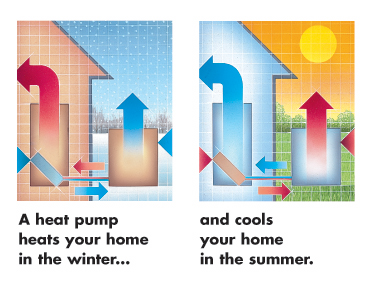
Q&A – Should I get a high efficiency heat pump?

A friend dropped me this email yesterday, asking for some advice (slightly edited):

We spent a lot on oil last winter.  We have a 23 year old heat pump which gives us A/C in the summer, but no heat any longer.  I had a proposal from the installer for a new 14.5 seer heat pump replacement.
Here is the question: how much more efficient will that unit be compared to our old unit?  We are not convinced that it is worth the cost, so we thought you might give us a ball park estimate of potential savings.  Bottom line is enough: does this sound like a good decision?

This is such a great question, that I wanted to share it, and my answer, with the rest of you.

Let’s start with the basics – what is a heat pump?

Continue reading

LED Bulb under $10 at Lowes!

A friend just turned me on to this special deal at Lowes in Pennsylvania. The bulb, which he noted is manufactured by Feit (a highly reputable brand) is currently available for $9.98 at this link.

I just bought five more of the $20 Feit bulbs, so I was a bit chagrined to learn about this. But I’m happy for the rest of you. At under $10, there’s really little reason not to try a few of these around your home.

Keep in mind, this is a 40 Watt equivalent, so it’s not the brightest bulb around. However, it’s directional, so it’s good for those areas where you have downlights or other areas where the light output pattern doesn’t have to be totally uniform.

If you get one, please post your comments here. I’ll pick one up myself when I get a chance, but I’d love to hear your feedback.

update: I just looked at the ad more closely – it’s 50% off until 5/9/2011 so buy now!

How to Increase the Energy Efficiency of Your Existing Home

This post by an energy auditor in central PA summarizes a lot of the information required to make your home more energy efficient, all in one spot. It’s like you took all my posts to date and wrapped it up into a single article! Definitely worth a skim.

For those of your unfamiliar with ChrisMartenson.com, Chris is a scientist who, several years ago, started investigating peak-oil – the fact that at some point, you can’t extract oil from the Earth any faster, and from there, it’s downhill. As he investigated it, he got more and more worried, because pretty much everything we do depends upon having essentially an unlimited supply of oil.

Chris is passionate about this cause. So passionate that he produced a series of videos and is traveling the world giving lectures about how to prepare. At first it seems nutty, especially if you’re of the mindset that “technology will always find a solution”, but if you listen carefully and do your own research, you may find yourself buying in to what he says.

I started following him a few years ago, and combined what he said with what I learned from various investment newsletters and other sources. That gave me an advanced warning to shift from classical stocks into metals and mining a few years ago, before the market tanked and mining stocks skyrocketed.

Whether you agree with him or not, his “Crash Course” is well worth viewing as it provides additional insights that you can use to better understand the complex, resource limited world in which we’re now living.

Tip of the day: pre-rinse in cold water

In this day and age, most of us have dishwashers, and yet there’s still quite a bit of controversy over how to wash dishes. Some wash every dish by hand. Some just throw them in the washer. Others wash the dishes by hand then put them in the dishwasher to make sure they get really clean?

This is an energy efficiency blog, so I’m going to look at this from an energy standpoint. If you live in New Mexico or elsewhere where water is in extremely short supply, you’ll probably have methods that are more water efficient.

You might have noticed that things just aren’t washing as well as they used to. You’re not imagining things! In fact, new soaps are “phosphate free” and people all over are complaining that dishes no longer come out clean. I certainly have. Here’s one article about the topic.

Because of this, more people than ever are hand-washing dishes. Either as a pre-rinse or giving up on dishwashers. So energy efficient rinsing is becoming even more relevant.

Continue reading

The Sustainable Building Advisor Institute

It’s been a busy week for me with my startup, OurKudos.com, so I haven’t had much time to contribute to Ted’s Tips. But now on a rainy Friday night, I feel the need to decompress and talk about energy efficiency and sustainable building again!

I got an announcement today from the Sustainable Building Advisor Program, an organization dear to my heart. They have changed their name to the Sustainable Building Advisor Institute and launched a new website.

Why is this so exciting? The SBA program is a wonderful organization dedicated to training people in the world of sustainable building. Unlike so many organizations that have sprung up in the last few years simply to make a buck on the “green” excitement, the SBAi is truly about the teaching. It’s a very small organization of dedicated individuals, passionate about what they do.  Continue reading